Showing posts with label Robotics Congress. Show all posts

Sunday, June 4, 2017

ICRA 2017 Singapore

ICRA, the IEEE International Conference on Robotics and Automation, is an annual academic conference covering advances in robotics. It is one of the premier conferences in its field. This year I was invited to attend to its 2017 edition in Singapore.
Francesco Ferro (Pal Robotics CEO)
and  Alejandro Alonso (IR CTO)


With a superb organization and a beautiful location, the event included conferences of leading researchers and companies from all around the world, as well as workshops and exhibitors area. This last was where I spent most of my time, as I love the direct interaction with the companies and research centres. Also, in this kind of academic events, compared to trade fairs, you usually have the chance to directly find very technical people, able to explain you in very deep all the ins and outs of their products. 

Really, the robotics community is not so big yet, so we know each other. Therefore I had the pleasure to meet some good friends from companies like Infinium Robotics, PAL Robotics and Fetch Robotics between others.

Infinium Robotics is the company in Singapore where I work as CTO. I already wrote about this great company in one of my previous posts: "Infinium Robotics. Flying Robots".

PAL Robotics is a company in Spain well known for having developed some of the best humanoid robots in the world. I have very good relationship with this companies team since more than ten years ago. Great people, well motivated, well managed, that has been able to look out of the box and enter with bravery in the world of the robotics warehouse solutions, with robots like Tiago (seen in the previous picture) or StockBot.

Junyang Woon (CEO IR), Melonee Wise (CEO Fetch)
and Alejandro Alonso (CTO IR/Hisparob VP)
Fetch Robotics is also one of the big players in the robotics solutions for warehousing industry, 

But I met many other very interesting people and had amazing chats with people from companies so key in this field as Amazon Robotics, DJI or Clearpath Robotics, At the end of this post there is a full list of exhibiting companies.

I saw very interesting technology, like the reabilitation exoeskeletons from Fourier Intelligence (Shanghai), the Spidar-G 6DOF Haptic interface from Tokio Institute of Technology, the Haptic systems of Force Dimension and Moog, the dextrous manipulators of Kinova, Kuka, ABB, ITRI, the modular robot components of Hebi Robotics, Keyi Technology, the ·D motion capture technologies of Phoenix Technologies and Optitrack, the educational solutions of Ubitech, GT Robot or Robotis and many, many others, most of them ROS enabled. 

As I usually try to do in these sort of events, I recorded a "home made" video of the exhibition area to give you all a slight idea on technologies shown there.

ICRA 2017 Exhibitors verview

And last but not least, I want to thank my friends from SIAA (Singapore International Automation Association) for their always kind friendship and support. They organized also the Singapore Pavilion in this event. 

Ms LIM Sue Yin, Civic Seh (both SIAA) and
 Alejandro Alonso (IR/Hisparob VP)


List of exhibitors:

Monday, January 30, 2017

Hardware Technology Opportunities & Challenges

Some weeks ago I participated in a panel discussion at the IEEE HardTech Summit Singapore, about Hardware Technology Opportunities & Challenges for entrepreneurs, both from the technical side and from the financing side.

The panel was moderated by Mohan Belani, Co-Founder & CEO at e27 and the other panelist with me were Kelving Ong, CEO at Focustech Ventures and Alexa Zotova, Principal at Ruvento Ventures.


Although I was there as CTO of Infinium Robotics Singapore, my past experience as founder of my own company in Spain, Quark Robotics, gave me the opportunity to deeply enjoy the moment with the other panelists, more from the investors' side.

Here are some key ideas from the panel, that I would like to share:

  • There are great opportunities for Hardtech companies in the markets of Smart Cities, IOT, Robotics & Automation, Drones solutions, and Industry 4.0 (Read my posts about IOT and Robotics in Smart Cities and Drones Market in figures for more detail)
  • In the case of Singapore, the Government created the National Robotics Programme (NRP), a funding programme of more than $450 million to support SMEs over the next three years. A great opportunity indeed.
  • In the case of small startups, there are some rules of thumb that should be considered when trying to get investors: (a) Getting a first financing from family & friends is always something that external investors will consider as an important commitment.  (b) You could not go to find investors with just an idea. you need to have a prototype, a proof of concept to make them feel confident on you. (c) Obviously a Business Plan, but with considering three scenarios: Optimistic, pessimistic and conservative, and also a Plan-B in case things goes wrong. (d) your product/service should be scalable, (e) You should demonstrate that you are focused on the market. Having agreements with future potential customers to help define and validate the product/service is a valuable point.
  • Where to find mentors for an entrepreneur: There are several sources (a) other entrepreneurs, preferably with at least 2 years of experience, either if they succeeded or not, (b) investors (c) potential customers, (d) Business Development professionals, who could share their knowledge of the market.
  • There are several challenges that hardware startups usually miss out or don’t look at early on: (a) Sometimes they are very optimistic and very technical focused (not market) (b) R&D takes time and money that commonly are not properly considered. (c) the Integration part is the key technical issue in any tech startup. Sometimes, this point is not even considered.
  • A jump from a prototype to a final product (industrialization phase) is a serious step. The prototype could fail, the product not. There are also regulations and certifications (Like CE, FCC,...), usability aspects and even the design of the box, manuals, support,... that sometimes are nor adequately considered, mainly due to lack of knowledge or experience in this critical phase.
You may find more interesting points in my previous post: What is the key to get the successful product?


Friday, December 23, 2016

AREX & SIRE. 2016 Robotics Exhibitions in Asia

I had the opportunity to visit SIRE (Singapore International Robot Expo) and AREX (Asian Robotics Exhibition) this past month of November 2016.

Many companies from different countries were there, exhibiting their products for various markets: Industrial, Military, Healthcare, Entertainment, Education, Security and F&B (Food and Beverages) mainly.

From what I see, South Korea, Japan, India, China, and Singapore are taking the lead in the Asian robotics markets, but some big "western" companies, like ABB or Universal Robots are also doing big business here in Asia.

One of the reasons of having a good growth in robotics development and adoption in Asia is due to the specific Government's grants for this purpose:

  • Singapore: As I mentioned in my previous post, Singapore have its Industrial Transformation Programme (ITP) [1]
  • South Korea will spend a total of 500 billion won (US$428 million) in the coming three years to foster the rapidly growing drone industry [2]
  • Japan announced their well known Japan's Robot Strategy in 2015 [3]
  • China made robotics a focal point of its recent “Made in China 2025” Plan, and has set national goals of producing 100,000 industrial robots a year and having 150 robots in operation for every 10,000 employees by 2020 [4]

Here you could see a small video I recorded as a summary of the companies and products exhibited in this past AREX 2016


-----
Sources:

[1] Industrial Transformation Programme (ITP)
[2] S. Korea to invest 500 bln won to foster drone industry in next 3 yrs
[4] Japan's Robot Strategy
[4] Robots at center of China’s strategy to leapfrog rivals

Friday, November 4, 2016

Spain - Singapore Robotics agreement

Past November 2nd, 2016 I had the pleasure to represent HISPAROB, the Spanish Technological Platform for Robotics, where I am Vice-President, in the signing ceremony of a Memorandum Of Understanding (MOU) between HISPAROB and SIAA (Singapore Industrial Automation Association). The event took place in the Singapore International Robot Expo (SIRE).

From Left to Right: S.C.Cheong (Treasurer SIAA), Oliver Tian (President SIAA), Alejandro Alonso (VP HISPAROB), Terence Teo (VP SIAA)

The Spanish Technological Platform for Robotics, HISPAROB, is a non-profit association, formed by about 100 members between companies, universities and research centres in Spain/Europe. It addresses the need to enhance robotics in Spain. It promotes and encourage initiatives aimed at creating robotic products and services useful for the Society.

Singapore Industrial Automation Association, SIAA is the leading hub for Automation, IOT and Robotics technologies, solutions & applications in Singapore. It also serves as a business catalyst in the APAC region.

The MOU signing is the starting point for a mutual collaboration focused on finding synergistic relationships between both countries. 

Wednesday, September 16, 2009

Robot World 2009. The South Korean Robotics exhibition

This is an article I wrote for an Northamerican journal after I returned from South Korea:


Robot World 2009

The South Korean Robotics exhibition


In 2003 South Korea, a country located between China and Japan, identified the intelligent robot industry as one of its new growth industries. Since then the efforts of this country has made possible to include Korea in the list of the ten most advanced countries in the area of intelligent robotics. In fact, the objective of this country is to be the most important developer of intelligent robots in the world by next decade.  

The exhibition


This year we attended the fourth edition of Robot World, one of the most important robotics exhibition events in Asia, where more than 100.000 visitors came to the city of Busan at South Korea to see the most advanced developments of this country.  More than 60 companies and research organizations participated in this event, than combined an expo area, a robot competition and a conference congress.


The interesting thing of this exhibition was the presence of robots for very different applications, from industrial robots, to educational robots, not forgetting other applications like military, social, disability, civil, entertainment or medical. Also the presence of Universities, R&D institutions and companies gave a wide offer between the state of the art robotics and more commercial solutions.

The robots


One of the robots that most surprised us was the quadruped from Kitech (Korea Institute of Industrial Technology), that seemed to be a version of the BigDog from Boston Dynamics. This four legged robot was designed to walk on rough terrain mainly for payload transport.

quadruped from Kitech

Kitech also showed their Korean singer woman robot and other wheeled robots for home duties.

Korean singer woman

In the same way as the quadruped from Kitech was the development of the quadruped from the Pohang Institute of Intelligent Robotics called PQ1-PIRO for research purpose in dynamic walking. Previous researches on dynamic walking of quadruped robots have used only walking pattern called central pattern generator (CPG). In this research, different from walking generation with only CPG, a instinctive stability measure called landing accordance ratio, is used for increasing dynamic stability. In addition, dynamic balance control and control to adjust walking trajectory for increasing dynamic stability measure is also used in this robot.

PQ1-PIRO

The Pohang institute also showed their research in underwater autonomous cleaning robots (Piro-U2), capable of working at 10m depth and able to clean 100 tons of dust per hour. This 300 kg robot use underwater cameras for the autonomous navigation.

Piro-U2

Another development of the Pohang Institute was Popo, a wheeled humanoid with a cat like face for museums, and other public events where the robot could be a point of information for the visitors. With its interactive screen, the visitors could see where they are, what to visit and get more information of any activities in the venue.

Popo

The Center for Cognitive Robotics Research (an area of KIST, Korea Institute of Science and Technology) showed their humanoid Mahru III, a walking robot that is an evolution of other previous versions. Every hour there was a demonstration of the robot walking and interacting with people.

Mahru III

Also we saw demonstrations of the Mahru-M, that is a wheeled version able to prepare the breakfast for its human pals. Very interesting when we wake up lazy on a Sunday morning.

humanoid Mahru-M from KIST

KETI (Korea Electronics Technology Institute) showed several of their developments, like the humanoid Kebox still in development, the service robot Kebo, or a wheelchair able of climbing stairs.

Kebox from Keti
Kebo from Keti
wheelchair from Keti
Other interesting wheelchair was the one from Ntrex company, that used omnidirectional wheels. This kind of wheels allowed the driver to move in any direction by the use of a unique joystick.

wheelchair from Ntrex
Robotech company showed their small Life Care robot Hali and the human sized PGR-4, an information service robot that we found also in a museum at South Korea. The main difference we found in this robot was the possibility of using two screens: One at the chest and another optional one over the head. This last was more or less in front of the eyes of the human user. This 95kg robot uses a PC Core 2 Duo platform with windows XP. Like the roomba cleaning robots, this robot could find its charge unit and take a breath of electricity when batteries become exhausted.


PGR-4 and Hali from Robotech

We found many other information service and telepresence robots offered by other Korean companies in this event. This shows an increasing interest in this area.

In a professional service area we found some interesting fire fighting remotely controlled vehicles. Hyundai Rotem company showed a couple of quite large fire fighting platforms prepared for fires where firemen have difficult access.  As well DRBFatec showed some medium size robots for the same purpose.

Hyundai Rotem

DRBFatec
Additionally they were companies developing the more common robots seen everywere, like educational and entertainment robots, floor cleaning robots, and parts, like motors, sensors and all this stuff.

In summary they were more than 60 Korean companies and other research institutions showing their last researches and products. A window to the state of the art in that country.

The contest


We also attended the IRC 2009, the international robot contest organized by Kitech as part of the same event.

It was a four days contest where 3.000 teams with 6.000 participants demonstrated their abilities in the eight competitions:

·         Grand Challenge (Performing missions),
·         Robotpiad (cleaning robot competition),
·         Humanoid (Fighting, Dance, Survival, Basketball, Skill Performance, Curling, Obstacle, Relay),
·         Intelligent SoC Robot War (SoC Tank Robot: A game in which tank robots attack enemies through an image recognition system with laser cannons, SoC Taekwon Robot: Two-legged humanoids attack each other using Taekwondo moves through an image recognition system),
·         FIRA challenge Cup (Football game of robots made in same form),
·         Robot festival (Line-tracer and other competitions for collegian),
·         Robot Olympiad and
·         Busan Robot Contest (Exhibiting and evaluating family-made robots)


It was really incredible to see the amount of small children participating in this kind of contests with very advanced robots. This is due to the education at schools in Korea, where they learn robotics as part of their ordinary education.

Conclusions


South Korea, a country that used to be far away from the technology is becoming one of the most advanced countries as technology producer, mainly in the area of robotics. This country is betting for the technology as a top priority driver for their future. They take care of the education, the research institutions, the technology transfer between universities and companies and the relationship between companies. Korea is preparing a very fast growth in this area that will undoubtedly surprise us sooner than we expect. Stay tuned.

Alejandro Alonso-Puig
Quark Robotics
www.quarkrobotics.com

Robot World website: http://www.robotworld.or.kr/

Tuesday, November 15, 2005

TVE2 channel. "A Ciencia Cierta". Robotics in Cadiz. Spain


Program "A Ciencia Cierta" broadcasted at "La 2 de Televisión Española" and the International channel to all Europe and America.

News article of three minutes about the Andalusia Week of the Science. The clip shows among others, the robot Melanie-III developed by Alejandro Alonso Puig, as well as an interview to him about the evolution of robotics.


Thursday, September 22, 2005

Clawar 2005 Climbing and Walking Robots Congress (London-UK)


From the 12th till the 15th of September 2005 there was in London the Congress of Climbing and Walking Robots CLAWAR 2005. Between the activities of the event they were 120 lectures from scientists of 30 countries, a robotics workshop, a climbing robots competition, visits to the climbing robots laboratory and several robotics exhibitions.


Mr. M. Osman Tokhi, General Chair of the congress in the official opening of the event.
The lectures covered areas of such interest as:
  • Sensing and Sensor fusion
  • Bioengineering and Biological Inspired systems
  • Flexible manipulators
  • Humanoid robots
  • Control of Climbing and Walking robots
  • Locomotion
  • Space applications
  • Modular, Reconfigurable Robots, Modularity
  • Design methodology
  • Software environments
  • Climbing, Navigation & path planning, Gait generation, Manipulation
  • Power, actuation, efficiency
  • Hopping & Legged robots, Analysis, Teleoperation
  • Personal assistance & Industrial applications
  • Security and Surveillance

Between the 14 Spanish participants they were members of IAI (Robotics Automation Institute of Madrid [CSIC]), Robotics Lab (University Carlos III of Madrid), IRI (Instituto de Robotica e Informática Industrial de Cataluña [UPC/CSIC]), Universidad Autónoma de Madrid and Quark Robotics among others, with a total of 20 papers presented.

Juan González (IEARobotics/UAM) during his lecture about modular robotics


The three Spanish robots presented during the exhibitions where Cube Revolutions and Multicube from Juan González (Universidad Autónoma de Madrid) and Melanie-III from Alejandro Alonso Puig (Quark Robotics)

Alejandro Alonso (Quark Robotics) doing a demonstration of Melanie-III. 
Between the other robots showed it was the hexapod Lauron-IV, last creation of FZI Karlsruhe, from Germany. One of this units was bought by Spain for a research project. There is also one unit of the former version Lauron-III at Barcelona, at the IRI (UPC-CSIC), where PhD. Enric Celaya and his team work in advanced research projects.

PhD. Enric Celaya (IRI) and Alejandro Alonso (Quark Robotics)
watching the splendid hexapod Lauron-IV  (FZI)
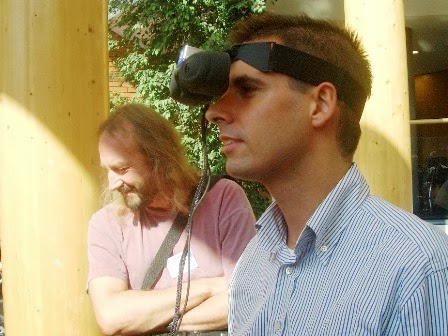
Juan González (IEArobotics/UAM) trying the visual control system of the robot Lauron-IV . Over the virtual reality glasses there is an inertial unit which identifies the movements of the head of Juan González. At his side is PhD. Enric Celaya (IRI) 

Other interesting robot was the quadruped "AIMEE" from the University of Bremen, Germany, built with high efficiency valued in 500€ each (2005). The robot is able to walk, turn and creep when it has to overcome difficult areas or high ramps. The University of Bremen works in other interesting robotics projects in cooperation with so well known organizations as ESA, NASA or DARPA.

Quadruped AIMEE of the University of Bremen (Germany)

PhD. Man-Wook Han from the Vienna University of Technology showed his robot for space applications. Part of a project he is doing with ESA (European Space Agency). His robot could walk through a "spider net" in weightlessness.

PhD. Man-Wook Han (TU Vienna) with his robot for space applications. An his side is Alejandro Alonso (Quark Robotics)

The Shadow Robot Company showed their dexterous hand. It is a so realistic design that it has nails. The different joints are activated by artificial pneumatic muscles, composed by elastic structures with muscle shape that compress when they are inflated with air.


Juan González (IEARobotics/UAM) shanking hands with the robotics arm while Armando De La Rosa (The Shadow Robot Company) look with attention. The strength of the hand is really impressive, although adequately controlled.
Also they were very interesting robots in the climbing robots competition, were robots had to climb a vertical wall avoiding obstacles in the path. Some used magnetic methods with other used suction systems.

An undergraduate with his climbing robot

Other climbing robots that competed in the contest
As part of the event there was also a visit to the Climbing Robots Design Laboratory of the South Bank University, were they were different kind of robots, since the first climbing robot developed at Russia, to complex systems for verification of vertical pipes or liquid tanks.


From left to right. Alejandro Alonso (Quark Robotics), PhD. Anton Vitko (Slovak University of Technology) and Juan González (IEARobotics/UAM)

From left to right. Alejandro Alonso (Quark Robotics), Juan González (IEARobotics/UAM), PhD. Antonio Giménez (Robotics Lab UC3M), PhD. Ramón Barber (Robotics Lab UC3M) and Mario R. Arbulú (Robotics Lab UC3M)

Juan González (IEARobotics/UAM) and Alejandro Alonso (Quark Robotics) with Dirk Spenneberg (white shirt) from the University of Bremen and his team.
From left to right. Juan González (IEARobotics/UAM), PhD. Elena García Armada (IAI-CSIC), Samir Nabulsi (IAI-CSIC), PhD. Manuel Armada (IAI-CSIC) and Alejandro Alonso (Quark Robotics) during the conference banquet at the Royal Automobile Club.
From left to right. Alejandro Alonso (Quark Robotics), PhD. Roger D. Quinn (Case Western Reserve University - OH. USA) and Armando De La Rosa (The Shadow Robot Company)
From left to right. William A. Lewinger and Kathryn Daltorio (Case Western Reserve University - OH. USA) and Juan González (IEARobotics/UAM).
From left to right. Alejandro Alonso (Quark Robotics), PhD. Domenico Longo (University of Catania. Italy) and Juan González (IEARobotics/UAM)


Saturday, January 15, 2005

Magazine "Muy Interesante". Smash hit of Melanie in California


Magazine "Muy Interesante". Spain. Production: 350.000 monthly units
January 2005 edition. Number 284. 
Title: "Smash hit of Melanie at California"

The news article describes the visit of Alejandro Alonso-Puig to "RoboNexus", robotics congress that took place at Santa Clara Convention Center, California on October 2004. There he showed his robot Melanie-III. 
  • Click on the picture to access the complete news article.
  • For more information about the visit to California, click here