Showing posts with label UAV/RPAS. Show all posts

Thursday, April 27, 2017

Unmanned Systems Asia 2017

A few days ago (April 2017) I visited Unmanned Systems Asia 2017, an event organized by Experia in the Changi Exhibition Centre of Singapore. This year the event was mainly focused on drones, although it was possible to see a few other non-flying unmanned systems.

I made a very "home made" non-professional video of the event, just to give you all a general idea on what some companies and institutions where exhibiting there.

If you could not see the video clic here: https://youtu.be/pAlHVwIoyS8

Although I am sorry to say I found the event a bit limited on the number of exhibitors, I found some interesting players anyway:

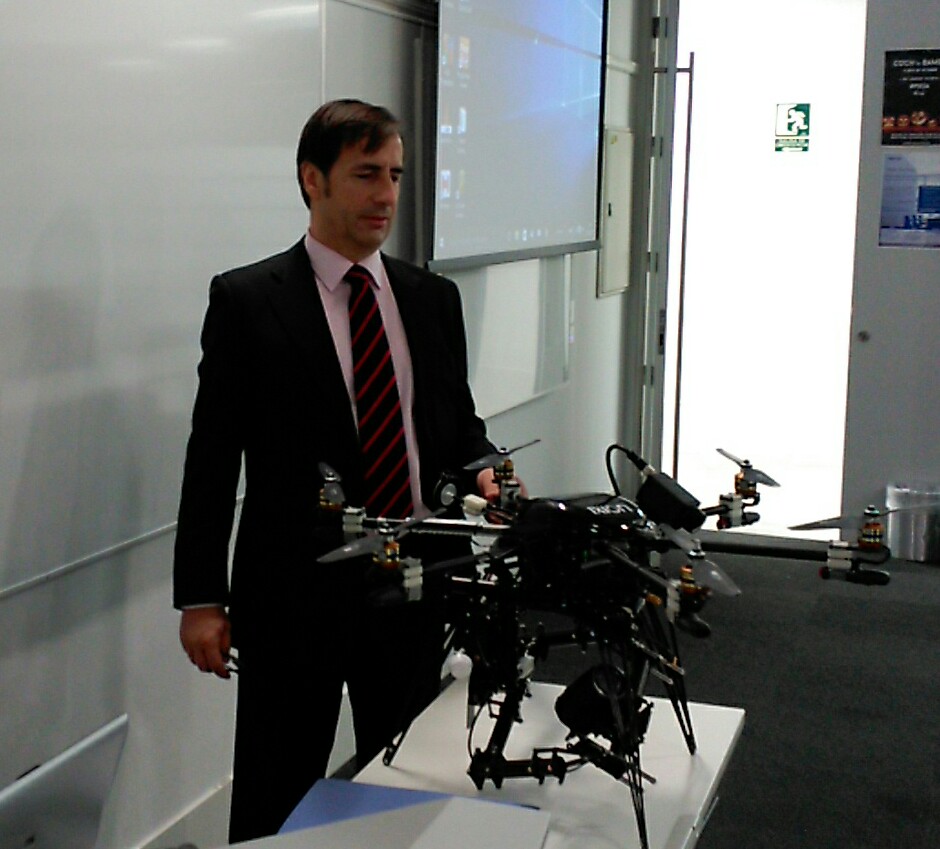
EWATT Technology, a Chinesse company that produce fixed-wing and rotary-wing systems, showed their big drones, mainly for industrial and security purpose. The company employs more than 300 people, including more than 80 R&D and technical support engineers in Chinese HQ, and two R&D centers located in Italy. EWATT has filed over 500 patents related to UAV embedded technologies in China, with a large number already approved The company showed a coaxial octocopter (EWZ-S8), but is also working on a gas-powered variable-pitch quadcopter (EWZ-110) with an expected endurance of 2h and 20kg payload.

ST Engineering (Singapore Technologies Engineering Ltd), an integrated engineering group providing solutions and services in the aerospace, electronics, land systems and marine sectors, ranks among the largest companies listed on the Singapore Exchange, and is one of Asia’s largest defence and engineering groups. Between the companies that form such group are: ST Kinetics, ST Dynamics, ST Aerospace, ST Marine and ST Electronics. Therefore they showed solutions from the different companies of the group. ST Aerospace showed their U-Star X quatrotor, specially
designed for urban and open terrain applications. and U-Star Y coaxial hexacopter. ST Dynamics showed their Autonomous Multi-Robot Exploration of Unknown Environments solution, based on a set of four-wheeled robots (Husky A200 developed by the Canadian company Clearpath Robotics), The solution is able to create a collaborative 3D map in real time, using 3D laser scanners and GNSS systems among others. They expect to have the solution ready for first trials within one year.

Lockheed Martin is one of the largest companies in the aerospace, defense, security, and technologies industry. This company offers a set of unmanned systems for underwater, air and land. In this event they showed their Indago quadrotor unmanned aerial system and also presented their recently launched Hydra Fusion, a photogrammetry software able to produce 3D maps in real time using a standard laptop.

Elbit Systems is an Israel-based international defense electronics company with more than 12.000 employees, engaged in a wide range of programs throughout the world. The company, operates in the areas of aerospace, land and naval systems, command, control, communications, computers, intelligence surveillance and reconnaissance ("C4ISR"), unmanned aircraft systems ("UAS"), advanced electro-optics, electro-optic space systems, EW suites, signal intelligence ("SIGINT") systems, data links and communications systems and radios. They showed some small unmanned aerial systems, including their well known Da-Vinci multirotor.

Let's see if for next year we could get some other players I missed, like... yeah, I think I will keep those names for myself ;-) 


Wednesday, February 15, 2017

Infinium Robotics. Flying robots

Infinium Robotics is the company where I work as Chief Technology Officer in Singapore. We do interesting things in this company mainly in aerial robotics, that I would like to share with you as far as I can, not unveiling our intellectual property.


Infinium Robotics is well known in Singapore as the first company able to use autonomous drones to serve food & beverages in restaurants, in a GNSS-denied environment (indoors). The solution is called Infinium-Serve. For that solution, Infinium Robotics not only uses its own developed drone platform and autopilot with adaptive controllers but also a very specific onboard computer vision system, that allows the drone to fly properly indoors in a safe way.

But this is not the only thing this company does. The expertise in sensors, control, trajectory planning and swarm robotics, allowed it to be one of the very first companies able to produce drone shows in the world, called Infinium-Waders, were multiple drones fly describing nice colorful moving figures up in the air, either indoors or outdoors. It is key in this case the automated coordinated trajectory planning, to prevent collisions between the drones while moving.

And the last, but not least is the automated solution for warehouses, called Infinium-Scan, where a complex system allows flying sensors move through a warehouse to do cycle-count stock-taking, also called physical inventory. The system is able to move autonomously in a GNSS-denied environment using different solutions, mainly based on computer vision, and LIDAR technology. The system could identify the goods available in the different racking levels through the aisles, to update de WMS (Warehouse Management System) inventory database. This automated system could reduce operating costs easily as well as increase the database reliability.

It is interesting to watch the following interview with CNBC about the company and our solutions.

If you could not see the video, access this LINK

If you are interested in knowing more about automation in warehousing industry, you could read my previous post HERE

Wednesday, September 28, 2016

UAVs in Asia

Some weeks ago I was invited to give a lecture at the Commercial UAV Show Asia 2016 at the Suntec Convention Centre in Singapore. The lecture was about Automation in Warehousing Industry, mainly focused on the area of UAVs, as the event was really about the UAVs market.

Apart from the pleasure of sharing this time in this so kind country, I had the chance to talk to representatives of many companies from different parts of the world. 

They were well-known companies in the Commercial UAV market as expected (DJI, Parrot, Yuneec, SenseFly, Aerialtronics, Tarot), with rotary and fixed wing solutions, but also I found some other solutions in this trade fair:

  • Hybrid fixed-rotary wing solutions: This is not something new. I saw this sort of solutions more than three years ago, but now I see they are getting mature. Companies like Aldara (Wincopter) or Aerolution Systems offered interesting machines.
  • Energy: Some companies like HES, Alta Devices or Ascent-Solar offered alternative sources of energy to the traditional LiPo Batteries. I expected more companies, as the size of this market is clearly huge.
  • Sense & Avoid solutions: Some companies, mainly start-ups offered solutions, mainly based on tiny radar technologies, like Fortem or RAN Systems, although DJI (Guidance) and Parrot (S.L.A.M.dunk) are also in the market.
  • Anti-Drone Systems: I saw only one company offering Anti-Drone solutions, what surprised me, as I expected more systems would be offered to the market. Teleradio was offering SkyDroner, an interesting solution, able to identify the drone radio signature, hack the signal and take control of the drone.
  • Other: Companies like Infinium Robotics offered solutions for Stock-Taking with autonomous drones in warehouses and Riegl offered powerful Lidars for terrain 3d Mapping between others.

I heard some people expected much more innovative solutions in this trade fair, but the reality is that the drones sector is maturing slowly, step by step. The main technical areas that require improvements are well known: flight endurance, sense & avoid (no collision), autonomous navigation in constrained areas and fail-safe reliable systems. The drone applications are available, but the former improvements are needed to give the professional drone market a real exponential growth.


Indeed, many companies worldwide around are working for this market, going after the Treasure Island, promised by most of the sales forecast statistics. But an important question is how to survive to this difficult, expensive and long trip. Unfortunately, I found many companies taking bad practices that may make them loose the race very soon:  
  • Some companies are trying to have a drone in the market that is not so different than competitors and not really cheaper.
  • Some companies are trying to develop complex innovative systems from scratch, being start-ups with not much funds. Developing anything for this market is expensive and requires much time and effort.
  • Some companies build complex systems that the users are not willing to pay for. Maybe because they are very expensive for what the customers really need, or because the target customers do not have the funds for such investments. Therefore the amounts of units sold are very low, not recovering the investment.
  • Some companies develop solutions that are non-scalable and do not pay attention to international markets. 
  • Some companies develop local solutions in countries with very restrictive laws for aerial navigation and therefore sales are far less than expected.
  • Some companies lose much time and energy in tailor made solutions for “important” customers that at the end do not give enough incomes, are not scalable and require a lot of personalized support.
  • Some companies expect in their business plans they will sell many units of their top quality, highly efficient but expensive systems the first year, but the reality is that in the majority of the cases, the first year the sales are low, as potential customers prepare their financial plans on a yearly basis, so they may not invest in expensive systems as soon as expected.
  • And last but not least, some companies do not value correctly the customer support and maintenance requirements for their products and get blocked with the amount of support required from customers, “bleeding” much time and money.
This is a new technology, still in its infancy, in a world that is becoming more and more global and commercially hungry and aggressive. Companies need to plan and execute very well to compete in this market.

Sunday, August 28, 2016

Automation in Warehousing Industry

I remember one of my early jobs when I worked for Honeywell as IT Director. We maintained those legacy Cobol applications, for Supply Chain, Finance, and Sales. Tailored made programs written to perfectly fit the Corporate way of working.

Also, I remember when the ERP concept showed up. A standard information system that, although could be parameterized / customized to some extent, required your organization to adapt to it, changing the way the organization used to work. In those days that seemed to be a bit annoying, but after a while, most of the companies realized that this was a better way to improve company results and reduce costs, than having to maintain fully customized applications and non-standard systems. 

For robotics, end-users will be forced to do the same to some extent. 

Yes, I know, we want a robot that solves our problems in our actual world (the Cobol concept), but the reality is that our world is complex, very complex for machines to do even simple tasks. We will need to standardize and adapt our world and our processes for the robots in order to help them be enough efficient, what will result in a better productivity at fewer costs (the ERP concept)

The warehousing industry is one of those industries that is experiencing a major transformation towards the automation. Thanks to this, we could nowadays buy something between more than 400 million products in Amazon [1] and get it in almost a day at home.

Companies like Amazon, as well as other major e-commerce and supply chain companies are transforming all their internal processes and their physical warehouses to incorporate automated systems, all of them connected to the heart of the warehouse: The Warehouse Management System (WMS)

Although there are several processes in a warehouse that could be automated, nowadays robotics and automation is offering better solutions mainly for storage&retrieval and for stock-taking. Let us explore these solutions:


Automated Storage & Retrieval Systems

An automated storage and retrieval system (ASRS) consists of a variety of computer-controlled systems for automatically placing and retrieving loads from defined storage locations [2]. 

ASRS. Source: Logistex

Retrieval of items is accomplished by specifying the item type and quantity to be retrieved. The computer determines where in the storage area the item can be retrieved from and schedules the retrieval. It directs the proper automated storage and retrieval machine (SRM) to the location where the item is stored and directs the machine to deposit the item at a location where it is to be picked up.

To store items, the pallet or tray is placed at an input station for the system, the information for inventory is entered into a computer terminal and the ASRS system moves the load to the storage area, determines a suitable location for the item, and stores the load. As items are stored into or retrieved from the racks, the computer updates its inventory accordingly [3].

Companies like Daifuku or Logistex are offering these sort of systems.

Sometimes among conveyors and lifts, there are also automated guided vehicles (AGV) as part of the ASRS system. A well-known example of this sort of robots is the case of Amazon, using Kiva robots for moving pods with items all around the warehouse.

Kiva Robot. Source: Wired 

Other examples of AGV that are used in ASRS for moving cargo are autonomous forklifts (as those offered by Seegrid), able to move autonomously through the aisles with different navigation technologies, storing or retrieving pallets.

hmiShelf. Source: Fetch Robotics
Also interactive autonomous conveyors are used mainly in e-commerce industry, helping to locate and move products. Warehouse associates and robots work together to reduce travel time and maximize time-on-task. Workers work more, walk less. It makes for a better, happier work environment. Several companies offer this sort of solutions, like Locus Robotics or Fetch Robotics, with hmiShelf robot, which have a touchscreen (the human-machine interface, or hmi) to tell the robot when the load is complete and where to deliver the items.

All these sorts of AGVs use different navigation technologies, generally based on magnetic or visual line following techniques, computer vision, Laser Range Finder and Sonar technologies, and other positioning and inertial systems. The key of this systems is that their Mean Time between failures (MTBF) should be very low, in an industry that requires sometimes 24/7 service. 


Inventory Management

Stock-taking may be performed as an intensive annual end of fiscal year procedure (physical inventory) or may be done continuously by means of a cycle count. Cycle counts contrast with traditional physical inventory in that a full physical inventory may stop operation at a facility while all items are counted at one time. Cycle counts are less disruptive to daily operations, provide an ongoing measure of inventory accuracy and procedure execution, and can be tailored to focus on items with higher value, higher movement volume, or that are critical to business processes. Cycle counting should only be performed in facilities with a high degree of inventory accuracy (greater than 95%). The purpose of cycle counting is to verify the inventory accuracy and even though it is not an adequate procedure to be used to correct inventory errors, it is an adequate way to identify the root causes of inventory errors [4].

There are several options to do an automated stock-taking with robots, both with AGV and Unmanned Aerial Vehicles (UAV) or more commonly named “Drones”.

The advantage of an AGV is that it could work for many continuous hours with no need to recharge, but normally could only do stock-taking of items located at low heights. The robots could use different techniques for items identification. The two most common are RFID technologies and Barcode technologies. The first one allows very fast readings of several items even being inside boxes. A RFID reader could do all readings at some distance from the items. The Barcode scanning requires a precise location of the barcode tag and reading them, so items inside of a box could not be identified. Therefore, RFID technology is recommended in e-commerce warehousing and retailing, while barcode tags are more adequate for box and pallets, and is a cheaper technology, as is based on printed paper.

There are several companies working on AGV/UGV robots for stock scanning, mainly for retail, like Simbe Robotics, 4D Retail Tech. Corp or Pal-Robotics with their Stockbot robot.

StockBot. Source: Pal-Robotics

In the case of big warehouses with cargo located at high racking levels, the stock taking is more complex. The traditional method requires people with scanners on Scissor Lifts moving through all the aisles, which requires time and prepared people. 

Using drones is an alternative to this way, either in a manual or in an autonomous way. The drone could embark the suitable sensors to read the tags (either RFID or Barcode) and send the information to the WMS for inventory update. About 95% of big warehouses use barcode tags as they are much cheaper that RFID tag, so here may be the big market.

Infinium Robotics at Singapore, the company where I work for as CTO, offers a solution for stock-taking based on drones. It is an autonomous solution, able to fly within GPS-denied environments, do stock-taking, update WMS database and recharge batteries when needed flying to docking stations. The solution is called Infinium Scan.

Source: Infinium Robotics

Wal-Mart announced in June that it plans to start using drones to handle stock-taking at one or more of its many warehouses starting next spring. A vice president with the firm said that a task of checking inventory levels that takes employees a month could be reduced down to a day by using drones.

But although there are many companies offering or working on automated solutions for the warehousing industry, one of the key questions we have to understand is: ¿Will your solution offer the ROI (or payback period) expected by the customer? Not always is a reduction in manpower cost what management looks for. All these solutions make supply chain companies more competitive, improve their quality service and therefore help them to get more or better customers, keen to pay more for a better service.

--
References

[1] (2015) How Many Products Does Amazon Sell? ExportX. https://export-x.com/2015/12/11/how-many-products-does-amazon-sell-2015/
[2] "Material Handling Industry of America - Glossary". http://www.mhia.org/learning/glossary/a
[4] Wikipedia Cycle Count: https://en.wikipedia.org/wiki/Cycle_count


Sunday, June 26, 2016

Drones + Energy efficiency > 2 hours flight time

There are two technologies that are highly fashionable nowadays: Drones and Energy efficiency (production, conservation, accumulation and clean energy). 

Actual drones, mainly those of multirotor type, use electric motors that need a huge amount of energy to keep the drone up in the air. We could say in very colloquial words that they use “Brute force” to “grasp” the air.  Up to now we have been using LiPo batteries for this purpose as they had the best energy density for its weight (about 200Wh/kg) compared to other batteries. But the reality is that drones with this sort of batteries are not able to fly more than one hour in the best cases, being 20 minutes the average flight time with payloads of 1 to 2kg. But is it enough? 

I remember some years ago, mobile phones had an autonomy of at least one week. Now if you get your phone working all day you are almost lucky. But this seems to be ok for us, by now. In the case of drone applications, there are a lot of applications that do not need more than half an hour flight sessions, but other actual and potential application would really benefit, if longer flight times could be reached, like Search & Rescue, Shipping/ Delivery, Precision Agriculture, Law-Enforcement and border patrol, Geographic Mapping, Search and Rescue/ Healthcare.

Fortunately, some light is seen at the horizon for flight times increase. There are several improvements in the Energy Efficiency fields that will help drones have access to better energy density sources. 

hybrid (petrol-electric)

A few months ago I visited Quaternium, a Spanish company that announced the development of a multirotor drone prototype, able to fly four hours using a hybrid (petrol-electric) technology. This month (June 2016) they have announced their product HYBRiX.20, a multirotor drone able to fly 4 hours (2hr. with 5 kg. payload). 

HYBRiX.20 drone from Quaternium

They use a petrol engine that produce electrical energy for the drone motors, using a battery as an energy buffer. The theory is simple, but the complex part is to get the correct equilibrium between several factors: Energy conversion efficiency, weight and distribution, vibrations and noise control, long term mechanical reliability (robustness) and battery optimization between other. But what is more important, they were able to jump from a prototype to a sellable product to the real market. 

From left to right: Jose Luis Cortes (founder & CTO Quaternium), Alejandro Alonso, and Alicia Fuentes (CEO) 

There are other companies, like Top Flight, a North American company, producing hybrid (petrol-electric) multirotor drones able to fly 2.5 hours with one gallon (3.8 litres) of gasoline. The solution is said to have an energy density of 1,500 Wh/kg, more than 7 times over LiPo batteries.

Hybrid drone from Top Flight
But hybrid (petrol-electric) is not the unique technology available for improving flight times, although it is possibly the most efficient at this time. 

Graphene batteries

Graphene can make batteries that are light, durable and suitable for high capacity energy storage, as well as shorten charging times. The Spanish company Graphenano recently introduced, together with its Chinese partner Chint, graphene polymer batteries. The company expect to have commercial batteries at the end of 2016. The batteries are said to have a density of 1,000 Wh/kg. Independent analyses by TÜV and Dekra show that the batteries are safe and are not prone to explosions like lithium batteries.

Hydrogen fuel cell

A hydrogen fuel cell technology uses compressed hydrogen and oxygen from the air to generate electricity. The hydrogen and oxygen combine to form water, but the electrons from the hydrogen could be used as power supply for a drone, with a battery buffer. The only exhaust from the fuel cell is water vapor and refueling with compressed hydrogen takes a few minutes compared to recharging a battery, so it is also a clean source of energy. 

There are several companies working on the application of this technology for prototype drones. 

In USA the company Intelligent Energy is working on a multirotor drone prototype that can fly for 2 hours. 

Hydrogen fuel cell drone from Intelligent Energy

In Singapore a consortium of Singaporean institutions and private sector companies including HES Energy Systems, ST Aerospace, DSO National Laboratories, and the Future Systems and Technology Directorate of Singapore’s Ministry of Defense, have worked jointly to achieve a record 6 hour endurance, 300km flight on the Skyblade 360 fixed wing UAV built in Singapore by ST Aerospace. The Skyblade 360 fuel cell system developed by HES and DSO is extremely lightweight in comparison to lithium batteries that typically power this sort of aircraft, and it is also extremely compact: its 1L fuel cartridge holds 1000Wh of usable energy.

Skyblade 360
It is nice to see we are getting alternatives to the "old" LiPo batteries for the drones market. This will open the space for a lot of possible real applications in a short time. The future is very promising.

Written by: Alejandro Alonso-Puig. HISPAROB Robotics Platform Vicepresident, Infinium Robotics CTO and Quark Robotics Partner.

Saturday, February 27, 2016

Professional Drones Book finally published

I have to say with proud that finally I have published my book  about professional drones. At this moment the book is only available in Spanish with the title “Drones Profesionales. Usos y Técnica”, but I expect to translate it into English soon. 

This book intends to explain in depth the world of drones, mainly of multirotor type, both from the technical aspect, and from the operations in various professional applications.

The drones world is shown from its history, as well as from its current applications in sectors such as industrial inspections, farming, cartography or aerial filming, including information about the application and piloting tips for each case.

A book filled with information and tips on piloting, legislation, technical information about principles of operation, sensors, payloads, control stations, batteries, equipment optimization, etc.

A practical book for all those who wish to learn about the world of the professional multirotor drones, available in kindle format at Amazon worldwide at a very low price, to ease the distribution of knowledge to anyone who needs it: 


Written by: Alejandro Alonso-Puig. HISPAROB Robotics Platform Vicepresident, IXION Industry & Aerospace MR Systems Manager and Quark Robotics Partner.

Sunday, December 13, 2015

Drones: Mandatory for Business?

Recently I gave a class about Drones for Business Applications at the IE (Instituto de Empresa) of Madrid (Spain) as part of the IT Management & Digital Innovation Program. IE is one of the most important Business Schools, with 27 offices around the world. 

The participants attending to the class were professionals from different important companies. Professional people with different perspectives around the uses of drones and their applications, since what matter most for companies, as potential customers of this technology, is to have results that give them real added value to solve problems or take decisions as quickly as possible, at the lowest cost and with the less possible complexity.

Drones are fashionable nowadays and lot of people try to sell the idea that drones could do almost anything, but drones are not always the solution. In some cases even being a possible solution, other factors such as laws limitations, costs or risks could make drones not to be the appropriate solution. At the time of deciding if drones technology could help us, I suggest to ask ourselves the following questions:
  1. What problem do we need to solve?
  2. Is drones technology the unique, easiest, cheapest, fastest, less risky and feasible way to solve the problem?
  3. If so, is it better to buy a drone, or to contract a service company?

The first question and how to deal it is critical. For instance, if you are a farmer and your crop production is nice for you, apparently you do not have any problem, but what happens if there are new ways to improve your production and you do not do anything to use them (possibly because you do not know them), you may have a potential problem, because other farmers will use this new ways to have a competitive advantage over you. This will allows them to reduce prices or to improve the quality. We live in a competitive world and to know the state of the art and ways to continue being competitive is a key task of any company. In the case of farmers, technology give them tools to do what is called “Precision Agriculture”: a farming management concept based on observing, measuring and responding to inter and intra-field variability in crops. With the use of drones and multispectral cameras, it is possible to acquire and process images to derive maps of crop biophysical parameters. Also with wireless sensors networks is possible to measure parameters like temperature (air/soil), humidity (air/soil/leaf), wind or stem diameter [1]. Connecting this information with other databases, about climate statistics and other historical information, mixing everything in a cocktail, and calling it Big Data, we could get crucial information that can significantly reduce the amount of nutrients and other crop inputs used while boosting yields. Farmers thus obtain a return on their investment by saving on phytosanitary and fertilizer costs. This is just an example on how technology could give a competitive advantage.

The second question is also a key point. Nowadays that drones are so fashionable, it seems that they could solve all our problems, but maybe there are other ways to approach issues, may be simplest, cheapest, or just less risky. For instance, if you are thinking on the use of drones in cities, to ensure the delivery of urgent parcels for Christmas in less than half an hour instead of the day after, why drones are supposed to be so important for that? I receive my warm pizza at home in half an hour and I do not need a drone for that. 

In the case of the third question my opinion is always the same: If having your own drone and working with it is not your core business, then contract a specialized drone service company. They will do better, with lower economic impact. They will take the risks, maintain their own drones, prepare all the legal documentation and take care of the logistics; to sum up, give you what you need: The added value for your business. Do not waste your time and money trying to introduce this kind of technology in your operations if someone else could do it with less problems, without a learning curve and faster. The money you pay for the service will worth you the effort.


Written by: Alejandro Alonso-Puig. HISPAROB Robotics Platform Vicepresident, IXION Industry & Aerospace MR Systems Manager and Quark Robotics Partner.

------
References:
[1] Precision agriculture. Wikipedia. https://en.wikipedia.org/wiki/Precision_agriculture 

Saturday, November 21, 2015

Los drones en cifras


Extraído de mi próximo libro "Drones profesionales. Usos y técnica"

Veamos a continuación algunos datos estadísticos de los drones, que nos pueden hacer entender un poco mejor su posicionamiento en el mundo.

Si bien es cierto que el mercado de los drones genera muchos más ingresos en las aplicaciones para defensa, no es nada despreciable el volumen del mercado para el sector civil, en el que la mayoría de los equipos son de tipo multi-rotor, al contrario del caso de defensa, en el que la mayoría son de tipo ala fija. Por otra parte, La Asociación Internacional de vehículos no tripulados (AUVSI)  predice en su Informe 2015 del Impacto Económico de la integración de los UAV en EE.UU [1], que en 10 años (2015 a 2025) el mercado de los drones habrá creado en EE.UU. unos 100.000 nuevos puestos de trabajo y habrá generado un total de $ 82 billones en actividad económica. En la misma línea, los expertos de la Comisión Europea estiman que, para el año 2050, este sector habrá generado 150.000 puestos de trabajo en la zona y hasta 15.000 millones de euros al año en beneficios [2]. Por su parte Teal Group hace por su parte una predicción global, tal como se muestra en la siguiente gráfica.

Mercado Global de drones en billones de dólares americanos. Fuente Teal Group

Ya solo el inventario de drones de EE.UU. en 2013 era de 10.730 unidades según Teal Group, constituyendo un tercio del total de la flota de aeronaves en operación, la mayoría de ala fija.

Drones ejercito EE.UU 2013. Fuente: http://www.uasvision.com/

El Portal Statista , presenta el volumen de producción a nivel mundial estimado de vehículos aéreos no tripulados (drones militares) de 2013 a 2022, clasificados por sus diferentes tipos

Producción mundial estimada de drones militares. fuente: Statista

El mismo portal presenta el presupuesto a nivel mundial estimado para vehículos aéreos no tripulados (drones) de 2014 a 2023 (en millones de dólares). La estadística muestra el presupuesto mundial estimado para los vehículos aéreos no tripulados, comúnmente conocidos como drones, desde 2014 hasta 2023. En 2017, alrededor de 2,5 millones de dólares se destinarán a la investigación y desarrollo de vehículos aéreos no tripulados y alrededor de 4,6 millones de dólares en la adquisición de UAV.

Presupuesto mundial estimado para los vehículos aéreos no tripulados

Actualmente las aplicaciones militares dominan el mercado global de UAVs, aunque las aplicaciones comerciales irán remontando positivamente durante los próximos 10 años, fundamentalmente a partir de 2020. Actualmente se estima que los UAVs militares tienen copado el 89% del mercado y el de los civiles el 11%, esperándose un cambio hacia una cifra 86% / 14% respectivamente en unos 15 años [4].


Si bien es cierto que actualmente hay una competencia importante entre empresas del sector, también es cierto que la tarta va a aumentar su tamaño progresivamente, por lo que puede haber oportunidades muy lucrativas, cuyo crecimiento puede verse limitado o impulsado dependiendo en gran medida de las limitaciones legales, puesto que estas pudieran enfocarse prohibiendo situaciones de riesgo y por tanto de desarrollo de mercado, o bien podrían enfocarse en permitir opciones controladas que establezcan medidas seguras, pero que también den libertad a un desarrollo potente del mercado, como podría ser por ejemplo el establecimiento de pasillos aéreos para drones en zonas pobladas.

Así mismo el propio desarrollo de la tecnología fomentará soluciones más seguras, que permitirán la utilización de los drones en mercados que no nos podemos plantear con la tecnología actual.

En definitiva, queda mucho por avanzar. Las estadísticas, nunca infalibles y en ocasiones infladas, nos pueden dar una idea de hacia dónde apuntan las tendencias, pero lo cierto es que en el sector de la tecnología nadie es verdaderamente gurú, y todo está por descubrir, mejorar y aportar a nuestra sociedad.


Written by: Alejandro Alonso-Puig. HISPAROB Robotics Platform Vicepresident, IXION Industry & Aerospace MR Systems Manager and Quark Robotics Partner.

------
References:
[1] The Economic Impact of UAS integration in United States. March 2015. AUVSI. http://www.auvsi.org/auvsiresources/economicreport
[2] Silvia Leal. 2015. http://www.silvialeal.es/nos-ponemos-las-pilas/ 
[3] Portal Statista. Estadísticas y estudios de más de 18.000 fuentes: http://www.statista.com/ 
[4] “Unmaned aerial vehicle market”. Kavita Nagpal. 2015. Defence Proac. http://www.defproac.com/?p=2041

Wednesday, November 4, 2015

Drones. Medidas de seguridad

Aibot X6 UAV
 Go to English version

Extraído de mi próximo libro "Drones profesionales. Usos y técnica"

Quizá un drone multi-rotor de juguete, con un MTOW (peso máximo al despegue) de menos de 300g sea un producto relativamente poco peligroso, pero no podemos olvidar que los multi-rotores de uso profesional son vehículos con hélices afiladas que giran a gran velocidad y que tiene un peso a considerar. Un multi-rotor de 4Kg que cae libremente desde una altura de 40m, es como una piedra de 4Kg que se aproxima al suelo a una velocidad de 100km/h, que puede perfectamente matar a una persona. Además los multi-rotores utilizan baterías LiPo, que contienen litio, un componente altamente inflamable en contacto con el aire. Es decir que si al caer el multi-rotor al suelo, se golpean y rompen las baterías, se podría producir un incendio. En definitiva que hablamos de productos con un peligro potencial importante, si no se toman las medidas preventivas adecuadas.

Por ello, con el fin de evitar problemas en lo posible, debemos tomar algunas medidas como las siguientes antes de un vuelo:

  • Revisar el manual de operaciones del multi-rotor, que incluirá las operaciones a realizar y el protocolo de ejecución (encender emisora, conectar baterías, arranque del multi-rotor de esta o aquella manera, esperar las señales necesarias y tiempos prudenciales para la convergencia de datos de GPS y otros sensores, montar motores, elevación progresiva de potencia de motores, despegue….. ejecución de vuelos…. Aterrizaje, etc. )
  • Establecer un protocolo de ejecución de los vuelos
  • Disponer de una lista de material a llevar 
  • Disponer de los permisos y seguros que establece la ley.
  • Hacer un análisis de riesgos previo a los vuelos, en el que se considere qué factores pueden fallar, cuáles pueden ser sus consecuencias y cómo evitarlas en lo posible. Además de este análisis de riesgos, también llamado estudio de seguridad, hemos de establecer unas normas a cumplir en los vuelos, que prevengan de accidentes habituales. A continuación se plantean algunas de ejemplo:


  1. Piloto y ayudantes llevarán chaleco reflectante para ser identificados con claridad durante la operación.
  2. Se establecerá una zona circular de seguridad para despegue y aterrizaje de 8 metros de diámetro, de manera que nadie pueda acercarse a dicha zona excepto el propio piloto y ayudantes para operar el multi-rotor (colocar baterías,..). Esta zona estará identificada mediante cinta delimitadora 
  3. Un interlocutor explicará a los asistentes las operaciones a realizar y explicará a los mismos estas medidas de protección y seguridad.
  4. Existirá un sistema de extinción de incendios disponible a mano, que será utilizado en caso de incendio.
  5. Las baterías del multi-rotor serán almacenadas en estuches ignífugos durante su transporte. Solo piloto y ayudantes tendrán acceso a las mismas.
  6. La estación de tierra podrá ser utilizada, custodiada y transportada exclusivamente por piloto y ayudantes.
  7. El multi-rotor solo podrá ser manipulado, custodiado y transportado por piloto y ayudantes.
  8. El personal asistente al vuelo se encontrará fuera de la zona de seguridad.
  9. Se delimitará la zona de vuelos o bien se establecerán mecanismos para evitar la concentración de personas bajo la zona de vuelo establecida.


Además, conviene prestar atención a algunas otras consideraciones adicionales:

  • El pilotaje de multi-rotores atrae mucho la atención de la gente. En ocasiones se acercan curiosos al piloto y empiezan a hacerle preguntas de todo tipo. Esto puede despistar al piloto, que ha de prestar máxima atención al vuelo. Si ocurre esto lo más recomendable es que el piloto indique con educación a los curiosos que debe prestar atención al vuelo y que después puede contestar a sus preguntas. 
  • No volar jamás sobre nosotros mismos. 
  • Controlar el estado de las baterías, bien gracias a sistemas de telemetría que pueden informarnos del voltaje o porcentaje de batería restante, también se suelen utilizar sistemas instalados en el propio multi-rotor que avisan con pitidos al llegar a un nivel de voltaje bajo. Volar con bajo nivel de batería puede tener resultados impredecibles. Puede que el multi-rotor baje lentamente con control o que lo haga sin control. Algunos sistemas tienen un modo “fail Safe” que al quedarse sin batería toma el control y aterriza verticalmente en el lugar que esté, dándole igual que sea agua, una carretera, personas, animales, arboles,… Otros tienen un sistema de vuelta a casa automático en esos casos, pero debe estar correctamente configurado, para que tenga batería suficiente para poder ejecutar ese regreso sin caer por el camino. Debe conocerse por tanto esta capacidad, para no alejarnos más de lo que no pueda volarse de regreso con el remanente de la batería. Además apurar hasta el límite una batería afecta drásticamente en su vida útil.
  • Deben evitarse zonas pobladas, reservas naturales de aves, carreteras y en general lugares no autorizados o en los que el riesgo de accidente o daño sea alto, a menos que se tomen las medidas legales y preventivas que permitan ejecutar los vuelos dentro de niveles de seguridad razonables.
  • Debe disponerse de un seguro y todos los permisos necesarios para vuelos dentro de la legalidad. Esto es especialmente obvio si consideramos las consecuencias: imaginemos que volamos fuera de la legalidad sobre una zona de bosque bajo con hierba seca en verano. Se cae por cualquier razón el multi-rotor y provoca un incendio. ¿A quién le toca asumir las consecuencias?

Tengamos cuidado y valoremos los riesgos, para prevenir consecuencias que pudieran ser fatales.

Written by: Alejandro Alonso-Puig. HISPAROB Robotics Platform Vicepresident, IXION Industry & Aerospace MR Systems Manager and Quark Robotics Partner.

Saturday, September 26, 2015

New tendencies in Professional Drones World

Thursday 25th and Friday 26th of September 2015 was the International Drones Exposition for Civil Applications, ExpoDrónica at Zaragoza (Spain). 

Expodrónica has been the first exhibition of its kind to be held in Spain aimed at professionals involved with Drones. The International trade show has featured more than 80 exhibitors and about 3.000 visitors.

Expodrónica brought together the whole range of professionals involved in this business such as producers and manufacturers of applications in mapping, agriculture, gas emission measurement, land and urban planning, civil engineering work and film industry.

I attended it as visitor and found really very interesting things. The first thing I found was the increase of platforms available from different manufacturers from Spain.

Because of my daily work as Multirotor Systems Manager at IXION Industry and Aerospace, I have good relationship with lots of companies in the sector, both manufacturers of rotary wings as well as fixed wing equipments, like Dronetools, Aerotools, Usol, Inda,... It was nice to see them all at this event.


Mainly they were rotary wing drones at the Expo, both professional and hobby grade. Even I saw an impressive race between some of the most recognized aerobatic drone pilots in Europe. Those drones had peaks of speed of 120km/h!!

In the professional sector I found very interesting platforms. I noticed more and more a tendency on taking special care on the design. Up to now, we were used to see drones with lots of cables going around the core. Here I found most of the professional drones with smart designs, able to support rain and using folding arms, a very important characteristic in professional drones, that use to be quite big. There is nothing more terrible than a case, so big for storing a drone, that you need a truck to transport it. Medium size cases with wheels and hanger is what I found in these event, with folding arms, huge propellers and pancake motors from TMotor and KDE mainly. Seems that AXI motors has lost the battle, at least in Spain, by now.

Drones of about 1h autonomy is the tendency for professional equipments. Better batteries, more efficient motors with very low turns rate, huge propellers and very light carbon fiber bodies, allow this increment in autonomy with payloads from 1kg up to 10kg. Multirotors are becoming to seem more aeronautic aircrafts than hobby-pro equipments, as they seemed to be just one or two years ago.

Things are changing indeed in the multirotor drones world.

Thursday, March 12, 2015

HOMSEC 2015. Mesa redonda sobre RPAS

Hoy he asistido a HOMSEC, el Salón Internacional de Tecnologías de Seguridad Nacional en Madrid, donde he sido invitado a participar como ponente en la mesa redonda titulada "RPAS: Amenazas, capacidades y apoyo logístico", moderado por el General Manuel Gimeno, Jefe de la División de Logística. EMACON. 

De dcha. a izda.: D.Manuel Oñate (Dtor. Desarrollo de Negocio. Unmanned Solutions), D.Manuel Martín (Responsable de proyectos RPAS. Triedro), Coronel Andrés Gamboa (Sección de Recursos Materiales de la División Logística. EMACON), General Manuel Gimeno (Jefe de División de Logística. EMACON), Comandante Jorge López Ramos (Servicio Aéreo de la Guardia Civil) y D.Alejandro Alonso (P.Manager Sist. Multirotor. IXION)

La mesa redonda comenzó con la intervención de los miembros del Estado Mayor Conjunto y posteriormente con el miembro de la Guardia Civil, que transmitieron sus necesidades en el ámbito de uso de RPAS en sus operaciones.Ambos coincidieron en su necesidad de disponer de equipos de gran seguridad de uso, maduros, de rápido despliegue, gran autonomía, adaptable a diferentes condiciones climatológicas y entornos, con funcionalidades de sense&avoidance, integrados con sus sistemas, con despegue y aterrizaje automático y despliegue seguro.

A continuación intervinimos los demás ponentes en representación de nuestras empresas (Triedro, Unmanned Solutions e IXION), mostrando nuestras capacidades en el ámbito de los RPAS.

Ha sido una estupenda oportunidad para mantener un contacto directo con miembros del Estado Mayor del Ejército y de las Fuerzas y Cuerpos de Seguridad del Estado, de poner sobre la mesa deseos y propuestas, de estrechar lazos de interés mutuo y de mostrar a los participantes la manera en que podemos ayudar los fabricantes para mejorar la seguridad de las naciones.

Estoy especialmente agradecido al Grupo Atenea, organizador del evento, por haberme invitado tan amablemente a formar parte de él.

Wednesday, December 10, 2014

Normativas para aeronaves civiles pilotadas por control remoto (Drones/RPAS)

Desde verano de este año los medios de comunicación han informado insistentemente sobre las nuevas prohibiciones en España, en lo referente al uso de Drones/RPAS. El boom de ventas que están teniendo este tipo de equipos ha obligado a la publicación urgente de un Régimen Transitorio para la operación de aeronaves civiles pilotadas por control remoto en España (Real Decreto Ley 8/2014 de 4 de julio), como paso previo a la aparición de una legislación más definitiva y depurada, que aparecerá presumiblemente durante 2015. 


Las aeronaves civiles pilotadas por control remoto, cualesquiera que sean las finalidades a las que se destinen excepto las que sean utilizadas exclusivamente con fines recreativos o deportivos, quedarán sujetas a lo establecido en esta Ley.(Art. 51.Dos y Tres)

Es importante tener en cuenta que el cumplimiento de lo dispuesto en esta disposición no exime al operador, que es, en todo caso, el responsable de la aeronave y de la operación, del cumplimiento del resto de la normativa aplicable, en particular en relación con el uso del espectro radioeléctrico, la protección de datos o la toma de imágenes aéreas, ni de su responsabilidad por los daños causados por la operación o la aeronave. (Art. 50.1)

Este post pretende servir de resumen aclaratorio al Régimen Transitorio que aplica hoy en día. El documento completo puede consultarse en la publicación correspondiente del BOE, a partir de la sección 6ª (pag 52602)

El Régimen Transitorio diferencia entre RPAS de masa máxima al despegue (MTOW) mayor de 25kg y RPAS de MTOW hasta 25kg, aplicando a los primeros unas normativas más restrictivas que no analizaremos en este post, centrándonos solamente en los que la normativa establece para los RPAS de MTOW hasta 25kg.


Operaciones que incluye el mecanismo transitorio

Podrán realizarse las actividades aéreas de: 
  • Trabajos técnicos y científicos (también llamados operaciones aéreas especializadas o trabajos aéreos: Actividades de I+D, tratamientos aéreos, fitosanitarios y otros que supongan esparcir sustancias en la atmósfera o sobre el terreno, levantamientos aéreos, fotografía, vigilancia, observación y patrulla, incluyendo filmación y publicidad aérea, emisiones de radio y televisión, lucha contra incendio, operaciones de emergencia, búsqueda o salvamento,…).  (Art. 50.3)
  • Vuelos de producción y mantenimiento del fabricante u organizaciones de mantenimiento. (Art. 50.4)
  • Demostraciones aéreas de público restringido. (Art. 50.4)
  • Vuelos de programas de investigación. (Art. 50.4)
  • Vuelos de prueba de desarrollo. (Art. 50.4)
  • Vuelos de I+D realizados por el fabricante. (Art. 50.4)


Dónde se podrán realizar dichas operaciones

Se podrá operar solamente de día y en condiciones meteorológicas visuales, en zonas fuera de aglomeraciones de edificios en ciudades, pueblos o lugares habitados o de reuniones de personas al aire libre, en espacio aéreo no controlado y a una altura máxima de 400 pies (120m)   (Art. 50.3.b)

Estas operaciones podrían desarrollarse de las siguientes maneras: 
  • En línea de vista (VLOS: Visual line of sight), pero a una distancia máxima de 500m desde el operador y a una distancia superior a 8 km de un aeropuerto o aeródromo: Solo para aeronaves de hasta 25 Kg   (Art. 50.3.d.10)
  • Más allá de línea de vista (BVLOS: Beyond visual line of sight), pero dentro del alcance de la emisión por radio de la estación de control  y a una distancia superior a 8 km de un aeropuerto o aeródromo (15 km si se utilizan procedimientos de vuelo instrumental): Sólo para trabajos técnicos y científicos con aeronaves de MTOW < 2 Kg, siempre que dispongan de medios para conocer la posición de la aeronave y se realice la emisión de un NOTAM previo a la operación. (Art. 50.3.a)  (Art. 50.3.d.10)
Si el vuelo ha de ser cercano a un aeropuerto o aeródromo, será necesario establecer mecanismos de coordinación con éstos y documentarlos.  (Art. 50.3.d.10)

Cualquier operación fuera de estas condiciones requerirá la segregación del espacio aéreo, siempre fuera de aglomeraciones.de edificios en ciudades, pueblos o lugares habitados o de reuniones de personas al aire libre. (Art. 50.4)


Requisitos para poder operar

Existen requisitos tanto a nivel operador, como piloto, como aeronave:


Requisitos del operador (empresa que realiza la operación civil) (Art. 50.3.d)

  • Disponer de la documentación relativa a la caracterización de las aeronaves que vaya a utilizar, incluyendo la definición de su configuración, características y prestaciones. 
  • Realizar un estudio aeronáutico de seguridad de la operación u operaciones, en el que se constate que la misma puede realizarse con seguridad. 
  • Disponer de póliza de seguro u otra garantía financiera que cubra la responsabilidad civil frente a terceros por daños que puedan surgir durante y por causa de la ejecución del vuelo, según los límites de cobertura que se establecen en el Real Decreto 37/2001 
  • Establecer los procedimientos necesarios para evitar el acceso de personal no autorizado a la estación de control y a la ubicación de almacenamiento de la aeronave. 
  • Adoptar las medidas adicionales necesarias para garantizar la seguridad de la operación y la protección de las personas y bienes subyacentes. 
  • Disponer del manual de operaciones (Solo para trabajos técnicos y científicos) 
  • Realizar, con resultado satisfactorio, los vuelos de prueba que resulten necesarios para demostrar que la operación pretendida puede realizarse con seguridad. (Solo para trabajos técnicos y científicos)
  • Establecer un programa de mantenimiento de la aeronave, ajustado a las recomendaciones del fabricante (Solo para trabajos técnicos y científicos)

Requisitos del piloto (Art. 50.5)

El piloto deberá ser mayor de edad, disponer de certificado médico específico y acreditar unos conocimientos: 
  • Cualquier licencia de piloto (incluida la de ultraligero) o haberla tenido en los últimos 5 años o 
  • Certificado del temario teórico de piloto por una escuela autorizada (Listado de escuelas autorizadas) o
  • Certificado Básico de RPAS (para VLOS hasta 25 Kg) emitido por una organización de formación aprobada (Listado de escuelas autorizadas) o
  • Certificado Avanzado de RPAS (para BVLOS hasta 25 Kg) emitido por una organización de formación aprobada (Listado de escuelas autorizadas)
Además requerirá de un documento que acredite que disponen de los conocimientos adecuados de la aeronave y sus sistemas, así como de su pilotaje, emitido por el operador, el fabricante de la aeronave o una organización autorizada por éste o una organización de formación aprobada. 


Aeronave 
  • Deberán llevar fijada a su estructura una placa de identificación en la que deberá constar, la identificación de la aeronave, número de serie, así como el nombre de la empresa operadora y los datos necesarios para ponerse en contacto con la misma.  (Art. 50.2)
  • Deberán estar caracterizadas e identificadas incluyendo la definición de su configuración, características y prestaciones. (Art. 50.3.d.1)
  • Deben tener las medidas adecuadas para proteger a la aeronave de actos de interferencia ilícita durante las operaciones. (Art. 50.3.d.8)


Cómo y cuándo se solicita autorización  (Art. 50.6)

Los operadores de aeronaves de hasta 25 kilos de MTOW no necesitan solicitar una autorización para poder operar, únicamente tienen que presentar en AESA (Agencia Estatal de Seguridad Aérea) una comunicación previa con al menos cinco días de antelación al vuelo, debiendo incluir:

  • Los datos identificativos del operador, de las aeronaves y de los pilotos
  • Caracterización de las aeronaves (incluyendo la definición de su configuración, características y prestaciones)
  • El tipo de trabajos técnicos o científicos que se vayan a desarrollar o, en otro caso, los vuelos que se vayan a realizar y sus perfiles, así como de las características de la operación
  • Las condiciones o limitaciones que se va a aplicar para garantizar la seguridad. 

Junto con la comunicación, el operador deberá presentar:

  • Declaración responsable en la que manifieste, bajo su responsabilidad, que cumple con cada uno de los requisitos exigibles conforme a lo previsto en esta disposición para la realización de las actividades u operaciones comunicadas, que dispone de la documentación que así lo acredita y que mantendrá el cumplimiento de dichos requisitos en el período de tiempo inherente a la realización de la actividad. 
  • Estudio aeronáutico de seguridad. 
  • Documentación acreditativa de tener suscrito el seguro obligatorio. 
  • Manual de operaciones. (Solo para trabajos técnicos y científicos)   
  • Acreditación de la realización de vuelos de prueba con resultado satisfactorio (Solo para trabajos técnicos y científicos)
  • Programa de mantenimiento (Solo para trabajos técnicos y científicos)

AESA está obligada a emitir un acuse de recibo en el plazo de 5 días a contar desde el día de recepción de la documentación en el que figuren las actividades para cuyo ejercicio quedan habilitadas (por tiempo indefinido si son trabajos técnicos o científicos). Dicho acuse de recibo servirá para acreditar ante terceros que el interesado está legalmente habilitado para realizar esa actividad (por tiempo indefinido en el caso de trabajos técnicos y científicos). (Art. 50.8)


Consideraciones finales

Existen algunos puntos prácticos a tener en cuenta como son los siguientes: 

Uso en situaciones de peligro: El artículo 50.8 establece que los operadores habilitados conforme a lo previsto en esta disposición para el ejercicio de las actividades aéreas de trabajos técnicos o científicos, podrán realizar, bajo su responsabilidad, vuelos que no se ajusten a las condiciones y limitaciones previstas en esta normativa en situaciones de grave riesgo, catástrofe o calamidad pública, así como para la protección y socorro de personas y bienes en los casos en que dichas situaciones se produzcan, cuando les sea requerido por las autoridades responsables de la gestión de dichas situaciones

Uso en interiores: Los recintos completamente cerrados (un pabellón industrial o deportivo, un centro de convenciones, un domicilio particular, etc.) no están sujetos a la jurisdicción de AESA, al no formar parte del espacio aéreo. Los titulares de esos recintos pueden decidir si autorizan el vuelo de drones en su interior y en qué condiciones.

Filmaciones aéreas: "Esta primera regulación temporal permite el uso de drones, sobre zonas no habitadas y por ahora no está permitido el uso en ciudades o sobre aglomeraciones de personas al aire libre, como pueden ser parques de ciudades, playas llenas de gente, campos de fútbol., etc. Por lo que, en el caso de películas, se podrán usar siempre que no sea en zonas urbanas. Las manifestaciones, fiestas o conciertos por ahora no será posible grabarlos con drones, excepto que tengan lugar en recintos completamente cerrados" (AESA). Es decir que nada de filmar en bodas...

AESA publica respuestas a preguntas frecuentes en la siguiente pagina: Preguntas frecuentes sobre la normativa de drones