Showing posts with label Meetings & Visits. Show all posts

Sunday, November 24, 2019

The 8th Edition of Daegu Robot Expo (South Korea)

November 2019 has been the date for this edition of Daegu Robot expo, where we saw a variety of robots, mainly anthropomorphic, although we saw some few professional drones, UGVs, educational robots and parts.


  • Between the professional drones we saw a huge engine drone, a quadcopter with fuel combustion engine from ATD Lab.
  • Also a  fixed wing drone  from Joydrone, with vertical take off and landing
  • Man&Robot co ltd showed Automatic Screw Assembly Machine Using Cooperative Robot.
  • Ruben offered 3D vision guided robotics and Bin picking system based on Fanuc robots
  • Stäubli showed their well known robot arms as well as their Stäubli Robotics Suit of software
  • Educational robots company, distributed in Spain by Dahn Ghun company
  • Also we saw some smart 3d printers, using either PLA or ABS for non industrial creations.
  • Wego showed Ugvs mainly, from Clearpath as well as developed by wego. 
  • Einbot showed a deep learning visual inspection robot sorting solution
  • Oto Robotics showed their industrial articulated robots OTR-6 and OTR-20. 6 axis pick and place robot and 6 axis welding robot.
  • Woelsung TMP manufacturer of robots for testing and handling radioactive materials, showed one of their telemanipulators for handling of radioactive materials, drug production, nuclear applications including testing, medical applications, and pharmacy.
  • Hyundai robotics showed their huge clean robot for LCD glass screens manipulation as well as a variety of Industrial robots
  • Daiso cell. Showed their force sensors, torque sensors and load cells.
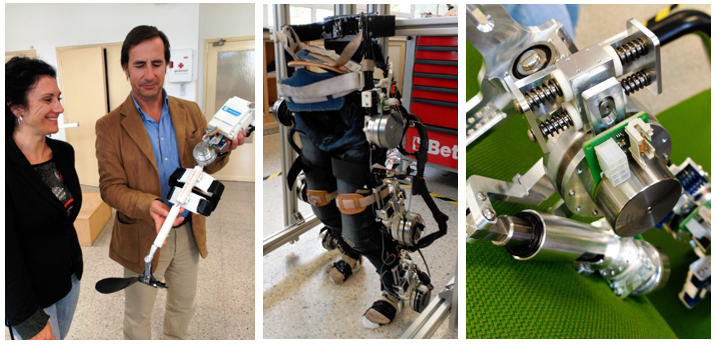
  • DGM Tech showed their rehabilitation exoskeleton
  • Yaskawa showed their general industrial robot solutions.
  • Sensor Solution showed some sennors for measuring displacement, preasure and torque.
  • and last but not least, Kuka showed one of their industrial robots

This was all from the 8th Edition of Daegu Robot Expo in South Korea.

by Alejandro Alonso Puig

Sunday, June 4, 2017

ICRA 2017 Singapore

ICRA, the IEEE International Conference on Robotics and Automation, is an annual academic conference covering advances in robotics. It is one of the premier conferences in its field. This year I was invited to attend to its 2017 edition in Singapore.
Francesco Ferro (Pal Robotics CEO)
and  Alejandro Alonso (IR CTO)


With a superb organization and a beautiful location, the event included conferences of leading researchers and companies from all around the world, as well as workshops and exhibitors area. This last was where I spent most of my time, as I love the direct interaction with the companies and research centres. Also, in this kind of academic events, compared to trade fairs, you usually have the chance to directly find very technical people, able to explain you in very deep all the ins and outs of their products. 

Really, the robotics community is not so big yet, so we know each other. Therefore I had the pleasure to meet some good friends from companies like Infinium Robotics, PAL Robotics and Fetch Robotics between others.

Infinium Robotics is the company in Singapore where I work as CTO. I already wrote about this great company in one of my previous posts: "Infinium Robotics. Flying Robots".

PAL Robotics is a company in Spain well known for having developed some of the best humanoid robots in the world. I have very good relationship with this companies team since more than ten years ago. Great people, well motivated, well managed, that has been able to look out of the box and enter with bravery in the world of the robotics warehouse solutions, with robots like Tiago (seen in the previous picture) or StockBot.

Junyang Woon (CEO IR), Melonee Wise (CEO Fetch)
and Alejandro Alonso (CTO IR/Hisparob VP)
Fetch Robotics is also one of the big players in the robotics solutions for warehousing industry, 

But I met many other very interesting people and had amazing chats with people from companies so key in this field as Amazon Robotics, DJI or Clearpath Robotics, At the end of this post there is a full list of exhibiting companies.

I saw very interesting technology, like the reabilitation exoeskeletons from Fourier Intelligence (Shanghai), the Spidar-G 6DOF Haptic interface from Tokio Institute of Technology, the Haptic systems of Force Dimension and Moog, the dextrous manipulators of Kinova, Kuka, ABB, ITRI, the modular robot components of Hebi Robotics, Keyi Technology, the ·D motion capture technologies of Phoenix Technologies and Optitrack, the educational solutions of Ubitech, GT Robot or Robotis and many, many others, most of them ROS enabled. 

As I usually try to do in these sort of events, I recorded a "home made" video of the exhibition area to give you all a slight idea on technologies shown there.

ICRA 2017 Exhibitors verview

And last but not least, I want to thank my friends from SIAA (Singapore International Automation Association) for their always kind friendship and support. They organized also the Singapore Pavilion in this event. 

Ms LIM Sue Yin, Civic Seh (both SIAA) and
 Alejandro Alonso (IR/Hisparob VP)


List of exhibitors:

Thursday, April 27, 2017

Unmanned Systems Asia 2017

A few days ago (April 2017) I visited Unmanned Systems Asia 2017, an event organized by Experia in the Changi Exhibition Centre of Singapore. This year the event was mainly focused on drones, although it was possible to see a few other non-flying unmanned systems.

I made a very "home made" non-professional video of the event, just to give you all a general idea on what some companies and institutions where exhibiting there.

If you could not see the video clic here: https://youtu.be/pAlHVwIoyS8

Although I am sorry to say I found the event a bit limited on the number of exhibitors, I found some interesting players anyway:

EWATT Technology, a Chinesse company that produce fixed-wing and rotary-wing systems, showed their big drones, mainly for industrial and security purpose. The company employs more than 300 people, including more than 80 R&D and technical support engineers in Chinese HQ, and two R&D centers located in Italy. EWATT has filed over 500 patents related to UAV embedded technologies in China, with a large number already approved The company showed a coaxial octocopter (EWZ-S8), but is also working on a gas-powered variable-pitch quadcopter (EWZ-110) with an expected endurance of 2h and 20kg payload.

ST Engineering (Singapore Technologies Engineering Ltd), an integrated engineering group providing solutions and services in the aerospace, electronics, land systems and marine sectors, ranks among the largest companies listed on the Singapore Exchange, and is one of Asia’s largest defence and engineering groups. Between the companies that form such group are: ST Kinetics, ST Dynamics, ST Aerospace, ST Marine and ST Electronics. Therefore they showed solutions from the different companies of the group. ST Aerospace showed their U-Star X quatrotor, specially
designed for urban and open terrain applications. and U-Star Y coaxial hexacopter. ST Dynamics showed their Autonomous Multi-Robot Exploration of Unknown Environments solution, based on a set of four-wheeled robots (Husky A200 developed by the Canadian company Clearpath Robotics), The solution is able to create a collaborative 3D map in real time, using 3D laser scanners and GNSS systems among others. They expect to have the solution ready for first trials within one year.

Lockheed Martin is one of the largest companies in the aerospace, defense, security, and technologies industry. This company offers a set of unmanned systems for underwater, air and land. In this event they showed their Indago quadrotor unmanned aerial system and also presented their recently launched Hydra Fusion, a photogrammetry software able to produce 3D maps in real time using a standard laptop.

Elbit Systems is an Israel-based international defense electronics company with more than 12.000 employees, engaged in a wide range of programs throughout the world. The company, operates in the areas of aerospace, land and naval systems, command, control, communications, computers, intelligence surveillance and reconnaissance ("C4ISR"), unmanned aircraft systems ("UAS"), advanced electro-optics, electro-optic space systems, EW suites, signal intelligence ("SIGINT") systems, data links and communications systems and radios. They showed some small unmanned aerial systems, including their well known Da-Vinci multirotor.

Let's see if for next year we could get some other players I missed, like... yeah, I think I will keep those names for myself ;-) 


Saturday, April 15, 2017

IOT Asia 2017

A few weeks ago I had the opportunity to be in IOT Asia 2017 (The International Exhibition & Conference on Internet of Things), held in Singapore Expo.

This year they covered may areas related to IOT: Smart Cities, wearables, industrial IOT, design applications, enablers, IoT Data Analytics, Cybersecurity and Robotics. With more than 70 speakers sharing different points of views about the present and future of IOT. I also was invited to give a lecture about the robotics in Spain and how through HISPAROB we are connecting Asia and Spain in the robotics area.

Alejandro Alonso Speaking at IOT Asia 2017

Also I was invited by SIAA and SingEx organization to be part of the panel of judges of the IOT Trailblazer Award, were G-Element won a well-deserved award for their product Nucleus, a 3D unified management system that interposes the real-time data avalanche of sensor networks with 3D building information to provide comprehensive situation awareness to premise managers. Also, Ambi Labs won a well-deserved award for their AmbiClimate indoor climate control applying Artificial Intelligence techniques. The awards were given by Dr. Vivian Balakrishnan, Minister for Foreign Affairs/Minister-in-Charge of the Smart Nation initiative.

In summary, IOT Asia 2017 was an interesting event, not only for the exhibition part, were we found innovative solutions, but also for the conferences, awards, and ambiance. My congratulations to the organization.

Friday, December 23, 2016

AREX & SIRE. 2016 Robotics Exhibitions in Asia

I had the opportunity to visit SIRE (Singapore International Robot Expo) and AREX (Asian Robotics Exhibition) this past month of November 2016.

Many companies from different countries were there, exhibiting their products for various markets: Industrial, Military, Healthcare, Entertainment, Education, Security and F&B (Food and Beverages) mainly.

From what I see, South Korea, Japan, India, China, and Singapore are taking the lead in the Asian robotics markets, but some big "western" companies, like ABB or Universal Robots are also doing big business here in Asia.

One of the reasons of having a good growth in robotics development and adoption in Asia is due to the specific Government's grants for this purpose:

  • Singapore: As I mentioned in my previous post, Singapore have its Industrial Transformation Programme (ITP) [1]
  • South Korea will spend a total of 500 billion won (US$428 million) in the coming three years to foster the rapidly growing drone industry [2]
  • Japan announced their well known Japan's Robot Strategy in 2015 [3]
  • China made robotics a focal point of its recent “Made in China 2025” Plan, and has set national goals of producing 100,000 industrial robots a year and having 150 robots in operation for every 10,000 employees by 2020 [4]

Here you could see a small video I recorded as a summary of the companies and products exhibited in this past AREX 2016


-----
Sources:

[1] Industrial Transformation Programme (ITP)
[2] S. Korea to invest 500 bln won to foster drone industry in next 3 yrs
[4] Japan's Robot Strategy
[4] Robots at center of China’s strategy to leapfrog rivals

Sunday, November 27, 2016

Haptic systems - Happy users

A few days ago I had the pleasure to meet some people from the National University of Singapore (NUS) Advanced Robotics Centre, who explained me some features of their researches on Haptic Systems.


A Haptic System recreates the sense of touch by applying forces, vibrations, or motions to the user. It is useful when you control a device (in this case a robotics arm), while you also receive feedback from the robot on the effort done or the tactile sensation.

Haptic systems have a long story, but their applications grow constantly. Technology users "need" to physically feel. The difference in the experience of using, for example a racing video-game with or without a force feedback (haptic) steering wheel is enormous. Not only you feel better the experience, but you control much better the car.

But is not only about games,is about almost anything that you need to control: A doctor operating a robot in a surgery, a scientist using a teleoperated arm to manipulate delicate materials, can be used to enhance the users’ immersive feeling when performing training in virtual reality environments, or tactile interaction with holograms, controlling remotely operated vehicles...

Basically, the use of haptic feedback can improve performance and sense of presence. Definitely, we will see more and more haptic applications in the near future, that will enhance our user experience and will make our life more productive, easier and happier.

Friday, November 4, 2016

Spain - Singapore Robotics agreement

Past November 2nd, 2016 I had the pleasure to represent HISPAROB, the Spanish Technological Platform for Robotics, where I am Vice-President, in the signing ceremony of a Memorandum Of Understanding (MOU) between HISPAROB and SIAA (Singapore Industrial Automation Association). The event took place in the Singapore International Robot Expo (SIRE).

From Left to Right: S.C.Cheong (Treasurer SIAA), Oliver Tian (President SIAA), Alejandro Alonso (VP HISPAROB), Terence Teo (VP SIAA)

The Spanish Technological Platform for Robotics, HISPAROB, is a non-profit association, formed by about 100 members between companies, universities and research centres in Spain/Europe. It addresses the need to enhance robotics in Spain. It promotes and encourage initiatives aimed at creating robotic products and services useful for the Society.

Singapore Industrial Automation Association, SIAA is the leading hub for Automation, IOT and Robotics technologies, solutions & applications in Singapore. It also serves as a business catalyst in the APAC region.

The MOU signing is the starting point for a mutual collaboration focused on finding synergistic relationships between both countries. 

Tuesday, February 16, 2016

Visiting Robotnik Automation S.L.L.

Part of my activities as Hisparob Vice-president, is to maintain good relationships with companies and institutions from the robotics sector. Therefore on behalf of Hisparob, I visited my friends Roberto Guzmán and Rafael López, founding partners of the company Robotnik Automation S.L.L. They received me in their new facilities at Valencia (Spain/Europe), where we had an interesting chat about the company, their origins and their success.

Robotnik, a company with fourteen years of history, twenty six employees and a revenue of three million euros per year, was in its origin a small company that almost born in a garage in 2002, focused at the beginning in the Industrial Robotics business.

Nowadays this company, certified ISO 9001:08 (Design, manufacturing and commercialization of products and systems based on robotics technology) and UNE 166002:06 (R&D management), is focused in the Service Robotics business, with a clear international orientation (70% of its revenue comes from international sales).


The main activity of the Company is the design, manufacturing, integration and sales of Service Robotics Solutions.

Their distribution agreements with important robotics companies (Schunk, Fetch, Kinova,…) is key for their success, because of their ability to create products based on their excellent robotics platforms with third parties manipulators. This is the case of their RB-1 Mobile Manipulator unit, that integrates a Robotnik mobile base with an arm from Kinova. See the picture above-left. Other successful products are the mobile platforms SUMMIT, GUARDIAN and AGVS.

One of their central pillars is to use ROS open control architecture in their robotics solutions, what drastically facilitate the integration of Robotnik products, with other products from the market.


From left to right: Rafael López (R&D Director. Robotnik), Roberto Guzmán (CEO. Robotnik), Alejandro Alonso-Puig (Hisparob Vicepresident)

Not only I enjoyed seeing a successful company with interesting products, but above all to share such a good time with its founding partners, passionate people for technology and willing to take the world by storm with their abilities, experience and dedication.

Written by: Alejandro Alonso-Puig. HISPAROB Robotics Platform Vicepresident, IXION Industry & Aerospace MR Systems Manager and Quark Robotics Partner.

Wednesday, October 21, 2015

Exoskeletons and Exosuits: Helping Disabled Children

A Wearable Robot (WR) is a kind of machine placed in close fit with the human body, thereby moving in synchrony with its limbs. The most common Wearable Robots are Exosuits and Exoskeletons. There are several practical applications that include assistance of elderly or disabled people as well as human performance augmentation for heavy-duty workers and military applications. 


The first time I saw an exoskeleton was on October 2004, when I attended the RoboNexus event at San José (California). Between other activities, they celebrated the Tetsujin contest where I saw several sort of exoskeletons, one of them able to lift more than 1.000 pounds. This was one of the sort of exoskeletons for human performance augmentation (EHPA), a mechatronic system placed in parallel to the operator’s body with the aim of increasing its strength [1].


Nevertheless, exoskeletons still present a number of ongoing challenges, including: 1) rigid links with pin joints resist the movement of the biological joints if they are not perfectly aligned and 2) exoskeletons require bulky self-aligning mechanisms [2].

Some years later, on 2007 I had the chance to meet Dr. Yoshiyuki Sankai, CEO at Cyberdyne Inc. from Japan, with whom I had a nice talk about the future of the exoskeletons, exosuits and other technologies for performance augmentation and medical applications. In that moment Cyberdyne Inc. had just 3 years. Now after more than 11 years is possibly the most advanced company manufacturing exoskeletons applications in the world.

Left picture: Dr. Yoshiyuki Sankai and Alejandro Alonso-Puig. Right Picture: A Cyberdyne exoskeleton

On October 2015, I went to visit Marsi Bionics the Spanish Startup company created by my friend PHD. Elena García Armada, roboticist at the Centre for Automation and Robotics - joint centre by the Spanish National research Council (CSIC) and Universidad Politecnica de Madrid (UPM). I   went to visit the company also with Melonee Wise (CEO at Fetch Robotics) and Angel Hernández (Fetch Robotics)

From left to right: Alejandro Alonso-Puig, Melonee Wise, Ángel Hernandez and Elena García

Marsi Bionics spun off from CSIC, devoted to contribute to restoring the quality of life of people suffering from locomotive disorders. With a multidisciplinary team of engineers, researchers and medical professionals, the company works in developing bionic exoskeletons for locomotion assistance, mainly for children.

Some statistics: 1% of the world population have walking disabilities. From them, 4% are adults with spinal cord injuries, 5% are children with neuromuscular diseases, 12% are children with cerebral palsy and spina bifida. The rest are elderly. About 18 million children cannot walk [3].

But the problem is not only this. The side effects of losing walking ability during a long time are malformations, scoliosis, respiratory dysfunctions, tissue necrosis, pneumonia, hip luxation, thrombosis, lack of self-esteem, problems for labor insertion and social integration. In some cases children dye due to the side effects.

As it has been stated in several research programs, the associated complications could be delayed, or even avoided if walking is maintained, so exoskeletons could help a lot in this situations.

Although Marsi Bionics was founded only two years ago (2013) its team has a background of 20 years research in walking robots and collaborate with medical institutions of reference in Spain, like La Paz Hospital (Madrid), Ramón y Cajal Hospital (Madrid), Sant Joan de Déu Hospital (Barcelona), Numen Foundation for Cerebral Palsy (Madrid) and FundAME Foundation for Spinal Muscular Atrophy (Zaragoza) between others.

The exoskeleton developed for children (ATLAS2020) is an orthotic devices that attached to the legs and trunk of users, reproduce the physiological gait, designed for daily use, with active joint rigidity control (for spasticity and spasms), 3D mobility (4 dof per leg) and adjustable in size, for children between 3 and 14 years old.

Also, they work on wearable exoskeletons for elderly (MB-Gold) and Single Joint Exoskeletons (MB-Active Knee) used in after surgery rehabilitation.

From left to right: 1.MB-Active Knee, 2.ATLAS2020 and a 3.joints and axels detail

In present times were technology consumism seems to be the top business, Marsi Bionics, a top qualified R&D company has decided to focus all the efforts to help children get a better life with technology. They accept donations and have a crowdfunding open right now. Money, that will help technology be accessible to those children that could not walk as we do as a normal action in our lifes. 

Written by: Alejandro Alonso-Puig. HISPAROB Robotics Platform Vicepresident, IXION Industry & Aerospace MR Systems Manager and Quark Robotics Partner.

------
References:
[1] M.Fontana, R.Vertechy, S.Marcheschi, F Salsedo and M.Bergamasco. “The Body Extender”. IEEE Robotics & Automation Magazine. Vol.21. No 4. December 2014
[2] A.T.Asbeck, S.M.M. De Rossi, I.Galiana, Ye Ding and C.J.Walsh. “Next-Generation Wearable Robots”. IEEE Robotics & Automation Magazine. Vol.21. No 4. December 2014 
[3] Marsi Bionics

Saturday, September 26, 2015

New tendencies in Professional Drones World

Thursday 25th and Friday 26th of September 2015 was the International Drones Exposition for Civil Applications, ExpoDrónica at Zaragoza (Spain). 

Expodrónica has been the first exhibition of its kind to be held in Spain aimed at professionals involved with Drones. The International trade show has featured more than 80 exhibitors and about 3.000 visitors.

Expodrónica brought together the whole range of professionals involved in this business such as producers and manufacturers of applications in mapping, agriculture, gas emission measurement, land and urban planning, civil engineering work and film industry.

I attended it as visitor and found really very interesting things. The first thing I found was the increase of platforms available from different manufacturers from Spain.

Because of my daily work as Multirotor Systems Manager at IXION Industry and Aerospace, I have good relationship with lots of companies in the sector, both manufacturers of rotary wings as well as fixed wing equipments, like Dronetools, Aerotools, Usol, Inda,... It was nice to see them all at this event.


Mainly they were rotary wing drones at the Expo, both professional and hobby grade. Even I saw an impressive race between some of the most recognized aerobatic drone pilots in Europe. Those drones had peaks of speed of 120km/h!!

In the professional sector I found very interesting platforms. I noticed more and more a tendency on taking special care on the design. Up to now, we were used to see drones with lots of cables going around the core. Here I found most of the professional drones with smart designs, able to support rain and using folding arms, a very important characteristic in professional drones, that use to be quite big. There is nothing more terrible than a case, so big for storing a drone, that you need a truck to transport it. Medium size cases with wheels and hanger is what I found in these event, with folding arms, huge propellers and pancake motors from TMotor and KDE mainly. Seems that AXI motors has lost the battle, at least in Spain, by now.

Drones of about 1h autonomy is the tendency for professional equipments. Better batteries, more efficient motors with very low turns rate, huge propellers and very light carbon fiber bodies, allow this increment in autonomy with payloads from 1kg up to 10kg. Multirotors are becoming to seem more aeronautic aircrafts than hobby-pro equipments, as they seemed to be just one or two years ago.

Things are changing indeed in the multirotor drones world.

Wednesday, September 23, 2015

Congrats KAIST friends!

Was 2007 when I had the pleasure and honor to meet Jun Ho Oh, professor of mechanical engineering at the Korea Advanced Institute of Science and Technology, who led the KAIST Team, who won in June 2015 the worldwide recognized DARPA Robotics Challenge (DRC) and its first prize of 1 Million Dollars.

Professor Ho Oh, came on 2007 from South Korea to Campus Party, the biggest LAN event in the world, were I was leading the organization of the Robotics Area (CampusBot), with his team from KAIST and Albert Hubo Robot. In that moment Hubo had a fully motorized Einstein face, able to reproduce not only mouth movements but face expressions. 

I found in Professor Ho Oh not only a brilliant mind now worldwide recognized, but also a very nice, sincere and friendly person, that was managing his team with a very close implication and understanding. Their robot did what was expected. In the picture I’m with him and with our respective robots: Hubo and Sam.


Professor Ho Oh and his team continued working in Hubo robot and improved it in order to perform real tasks in a real world. Therefore they won the prize. They deserved it. 

DARPA organized the DRC after the Fukushima disaster in Japan, expecting to advance the field of disaster robotics. The DRC Finals called for 23 teams of semi-autonomous robots partly controlled by human operators. The robots created by universities and companies included legged robots, wheeled robots, and hybrids robots as well. The following image shows the DRC Finals team standings, being on first position Hubo of TEAM KAIST from South Korea, on second position Running Man (Atlas) of Team IHMC Robotics from the Institute of Human and Machine Cognition in Florida/USA and on third position Chimp of Tartan Rescue Team from Carnegie Mellon University in Pennsylvania/USA.


The Robots had to perform things like drive a car, open a door, drill a hole in a wall, walk up stairs, open a valve and tread uneven ground. Also the Internet network that teams used to communicate with their robots at times didn’t work for 30 seconds or more, to simulate real-life conditions. Therefore this was a very difficult set of tasks to complete. Most of the robots didn’t perform some of the tasks, even most of them fell down sometime during the execution. But from my point of view it was a very interesting competition. People criticize that most of the robots failed, but most of the people don’t understand how difficult is to make robots perform like humans in real world. 

We made a world for humans. Everything in this world is prepared for humans (stairs, chairs, doors, vehicles), and this is the reason why most of the robots at DRC where humanoid robots, just to ease the execution of the tasks, but really is not a question of creating robots exactly like humans. There are better options, and teams like KAIST understood it when they decided to give HUBO the possibility of moving using legs or wheels, as well as being able to rotate its torso 180 degree. This couple of things between others showed that KAIST team did something great: Thinking very creatively, trying to find ways to even improve the human body limitations in some ways. My congratulations to the KAIST team. I wish them the best!

Recommended Links:

Thursday, March 12, 2015

HOMSEC 2015. Mesa redonda sobre RPAS

Hoy he asistido a HOMSEC, el Salón Internacional de Tecnologías de Seguridad Nacional en Madrid, donde he sido invitado a participar como ponente en la mesa redonda titulada "RPAS: Amenazas, capacidades y apoyo logístico", moderado por el General Manuel Gimeno, Jefe de la División de Logística. EMACON. 

De dcha. a izda.: D.Manuel Oñate (Dtor. Desarrollo de Negocio. Unmanned Solutions), D.Manuel Martín (Responsable de proyectos RPAS. Triedro), Coronel Andrés Gamboa (Sección de Recursos Materiales de la División Logística. EMACON), General Manuel Gimeno (Jefe de División de Logística. EMACON), Comandante Jorge López Ramos (Servicio Aéreo de la Guardia Civil) y D.Alejandro Alonso (P.Manager Sist. Multirotor. IXION)

La mesa redonda comenzó con la intervención de los miembros del Estado Mayor Conjunto y posteriormente con el miembro de la Guardia Civil, que transmitieron sus necesidades en el ámbito de uso de RPAS en sus operaciones.Ambos coincidieron en su necesidad de disponer de equipos de gran seguridad de uso, maduros, de rápido despliegue, gran autonomía, adaptable a diferentes condiciones climatológicas y entornos, con funcionalidades de sense&avoidance, integrados con sus sistemas, con despegue y aterrizaje automático y despliegue seguro.

A continuación intervinimos los demás ponentes en representación de nuestras empresas (Triedro, Unmanned Solutions e IXION), mostrando nuestras capacidades en el ámbito de los RPAS.

Ha sido una estupenda oportunidad para mantener un contacto directo con miembros del Estado Mayor del Ejército y de las Fuerzas y Cuerpos de Seguridad del Estado, de poner sobre la mesa deseos y propuestas, de estrechar lazos de interés mutuo y de mostrar a los participantes la manera en que podemos ayudar los fabricantes para mejorar la seguridad de las naciones.

Estoy especialmente agradecido al Grupo Atenea, organizador del evento, por haberme invitado tan amablemente a formar parte de él.

Saturday, January 24, 2015

HISPAROB. Arrancamos de nuevo


La Plataforma Tecnológica Española de Robótica (Hisparob) nació en 2010 con el fin de abordar la necesidad de potenciar la robótica en España, promoviendo y fomentando iniciativas orientadas a la creación de productos y servicios robóticos comercializables y útiles para la sociedad. 

La plataforma HispaRob partió de la financiación del Ministerio de Ciencia e Innovación (RET-020000-2008-8), dentro del Plan Nacional de Investigación Científica, Desarrollo e Innovación Tecnológica 2008-2011


El pasado 26 de Septiembre, la Plataforma Tecnológica Española de Robótica (HispaRob) se convirtió en asociación sin ánimo de lucro, a fin de poder relanzar sus actividades, establecer democráticamente su organización y dar un mejor servicio a sus miembros. 

Ayer día 22 de Enero de 2015 se celebró la primera Asamblea General de la nueva Hisparob. En ella se trataron en un diálogo abierto los siguientes temas:

  1. Constitución de la Asociación: Se informó a los socios de los pasos realizados para la constitución y se presentó a la Junta Directiva Constituyente, Cuyos Presidente y Vicepresidente son respectivamente Carmen Pérez Melguizo, representando a Tecnatom y Alejandro Alonso Puig, como socio de Quark Robotics. Los vocales son las empresas Asea Brown Boveri, S.A., PAL Robotics, S.L., Adele Robots, S.L., Robotics Special Applications, S.L., Micro-Log Tecnología y Sistemas, S.L., Logix5 Smart Solutions, S.L., Fundación Tekniker, Fundación Alzheimer España, Comité Español de Automática y la Secretaría Técnica la Universidad Carlos III de Madrid.
  2. Actividades propuestas por la Junta Directiva y expuestas a debate abierto a los socios participantes, entre las que se encuentran actividades de difusión de la robótica, actividades de apoyo a la I+D+i, actividades de apoyo a las actividades de los socios y su difusión y la creación de grupos temáticos 
  3. Se presentó y aprobó una cuota única especial para los socios, que este año 2015 será de 350€ por institución, teniendo cabida empresas, universidades, centros tecnológicos, asociaciones, organismos públicos, organismos de investigación y otras instituciones.

Personalmente quiero agradecer la confianza que Hisparob depositó en mí nombrándome Vicepresidente de la Junta Directiva Constituyente. Tengo un gran aprecio por Hisparob, pues creo que puede realmente apoyar de una manera eficaz el progreso de la robótica. Además, mi relación de muchos años con sus participantes ha forjado no solo una relación profesional, sino de amistad con muchos de ellos. Al fin y al cabo, no somos tantos aún en el mundo de la robótica profesional y nos conviene estar juntos para encontrar nuestras sinergias.


De dcha. a izda: 
Carlos Balaguer (Vicerrector de Investigación UCIIIM), 
Francesco Ferro (CEO Pal Robotics) y 
Alejandro Alonso (Multirotor S.P.Manager en IXION y Socio de Quark Robotics)


Saturday, May 31, 2014

Melanie-III demo at GMV for smart children


Last saturday, May the 10th Melanie III and I visited to our friends at GMV and a group of smart children. It is nice to see that companies not only focus on their own business, but also share some of their time and resources with students, allowing them to see some examples of technology. This time the visit was from PEAC, were children with high capacities could find ways for enrichment of their creativity and capacities. GMV showed some of the last works done in control of space ships and satelites, as well as with robots for explosive ordnance disposal. I was invited to show Melanie, my hexapod robot. Although Melanie III is actually 10 years old, is still working as the first day and may be an example of personal development that could help children to find their way to the technology. It was a pleasure to be there.

Here you could see Melanie III walking on the martian simulation arena at GMV:


For more information on Melanie-III clic HERE


Monday, March 10, 2014

Visit to UNVEX'14. III Congress of Unmanned Vehicles. Spain 2014

Last March 5th, 2014 I visited UNVEX'14, the III Congress of Unmanned Vehicles in Madrid (Spain). Companies as Airbus, Thales, Indra, or General Atomics showed their creations to a group of visitors from different segments of industry and military.

K150 unmanned aircraft from Unmanned Solutions Company

What first surprised me was the amount of UAVs showed, over any other kind of unmanned vehicles. QinetiQ, a British multinational defense technology company was the unique company showing one of their Small Unmanned Ground Vehicle Dragon Runner 10, a highly specialized system, light enough to be thrown over obstacles for reconnaissance missions, the DR-10 readily accepts a quick-attach manipulator arm for discovering and attacking threats. It is equipped for a wide range of applications, especially in congested urban settings – including: ordnance disposal, reconnaissance, inspection, and security. QinetiQ is well known for its robot TALON, the most widely used bomb disposal robot in the world today, with a cost of about  $60,000 in its standard form.

Dragon Runner from QinetiQ
They were several companies offering multirotor drones of different shapes, sizes and purpose. From those capable of flying with hard rainy and windy conditions, with 8 propellers, payloads of up to 2,5kg and 90 minutes flight time, to smaller units with 3 or 4 propellers, 30 minutes autonomy and 300g payload for narrow places. All of them with a variety of auto stabilized cameras (daylight and IR), manual or autonomous flight based on waypoints and automated vertical take-off and landing (VTOL). Companies like AV Aerovironment, Microdrones, Aibotix, AeroTools or Everis Aerospace and Defence showed their creations.


Also they were companies offering their unmanned aircraft systems, like the well known Predator C Avenger produced by General Atomics, a 20m wingspan drone, with a price of $12 million to $15 million widely used in by the United States Army in Afghanistan, Iran and Pakistan.

Predator C Avenger
Some other companies like AV aerovironment, SurveyCopter, Indra, Mavinci, Expace, Geotronics, Unmaned Solutions, Everis, INTA or Thales showed their own unmanned aircraft solutions. This sort of equipment is in most of the cases formed by a motorized structure, which includes an autopilot, a data link for communication and a payload designed for the mission to be carried out. The automatic guidance is based on a list of waypoints, which are specified by their coordinates in a 3D space. The cameras (daylight or infrared) are integrated in a gyro-stabilized gimbal which reduces the movement of the aircraft and allows the operator to point to the target or the scene of interest. There is a Ground Station that consists of some sort of control unit with joysticks used by an operator to prepare and monitor the mission in real-time, to visualize images in real-time and to record them. The Ground Station is coupled to a data link antenna which tracks the aircraft. They are versions that are launched by means of a catapult, mainly useful if they are launched from narrow spaces or vessels.


They were also companies with products or services for the sector, like GMV, or IXION, offering their Control Navigation and Mission (CNM) systems for unmanned vehicles. This system fits in any vehicle, giving it the level of intelligence and communication needed to be used as an Unmanned System.


In summary, it was a good opportunity to see the state of the art in unmanned vehicles and visit some friends from different companies in the market.