A few weeks ago I had the opportunity to be in IOT Asia 2017 (The International Exhibition & Conference on Internet of Things), held in Singapore Expo.
This year they covered may areas related to IOT: Smart Cities, wearables, industrial IOT, design applications, enablers, IoT Data Analytics, Cybersecurity and Robotics. With more than 70 speakers sharing different points of views about the present and future of IOT. I also was invited to give a lecture about the robotics in Spain and how through HISPAROB we are connecting Asia and Spain in the robotics area.
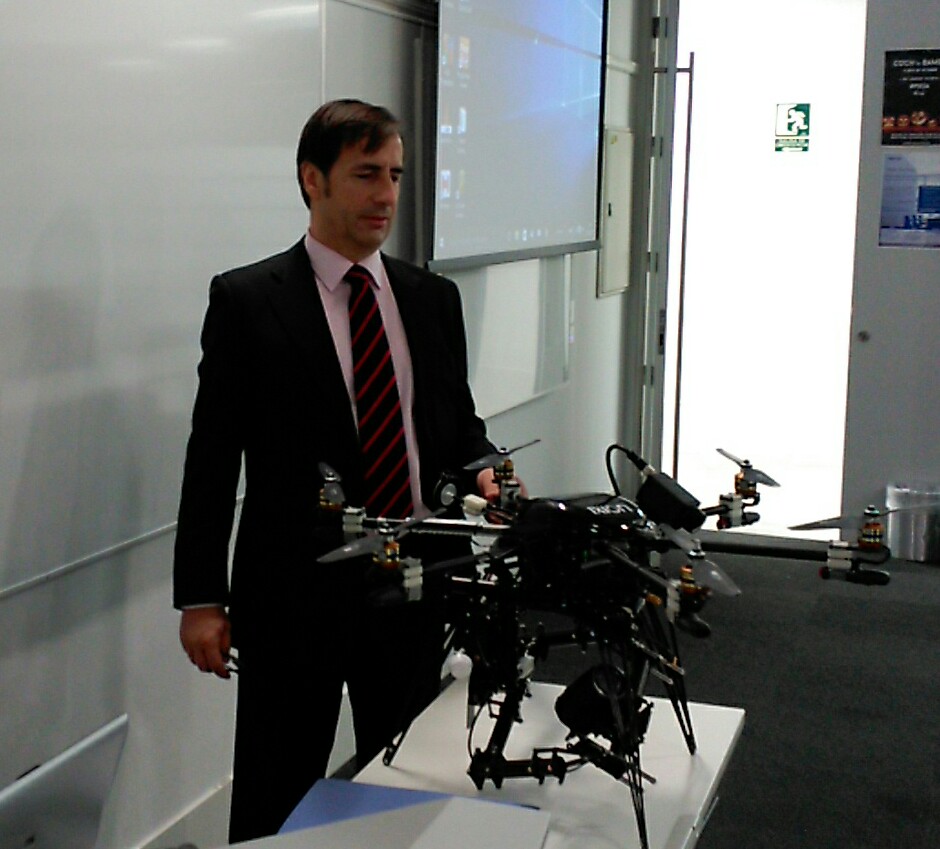
Alejandro Alonso Speaking at IOT Asia 2017
Also I was invited by SIAA and SingEx organization to be part of the panel of judges of the IOT Trailblazer Award, were G-Element won a well-deserved award for their product Nucleus, a 3D unified management system that interposes the real-time data avalanche of sensor networks with 3D building information to provide comprehensive situation awareness to premise managers. Also, Ambi Labs won a well-deserved award for their AmbiClimate indoor climate control applying Artificial Intelligence techniques. The awards were given by Dr. Vivian Balakrishnan, Minister for Foreign Affairs/Minister-in-Charge of the Smart Nation initiative.
In summary, IOT Asia 2017 was an interesting event, not only for the exhibition part, were we found innovative solutions, but also for the conferences, awards, and ambiance. My congratulations to the organization.
Some weeks ago I taught a class about Internet of Things and Robotics in the Smart Cities at the worldwide known IE Business School of Madrid, where I am Associate Professor. Here I share some of the information I showed in the class.
Smart Cities
In 1900, 13% of the world population lived in cities. In 2050, 70% will live in cities as per the prediction from United Nations. This represent a growth of seven cities as New York added to our planet every year.
With this prediction, it is easy to imagine that unless things change, it will be difficult to manage such population growth. In order to solve this potential problem, the concept of Smart City came to us.
As clearly explained in Wikipedia: A smart city is an urban development vision to integrate multiple information and communication technology (ICT) solutions in a secure fashion to manage a city’s assets – the city’s assets include, but not limited to, local departments information systems, schools, libraries, transportation systems, hospitals, power plants, water supply networks, waste management, law enforcement, and other community services. The goal of building a smart city is to improve quality of life by using technology to improve the efficiency of services and meet residents’ needs. The information and communication technology involved allows city officials to interact directly with the community and the city infrastructure and to monitor what is happening in the city, how the city is evolving, and how to enable a better quality of life. Through the use of sensors integrated with real-time monitoring systems, data are collected from citizens and objects - then processed and analysed. The information and knowledge gathered are keys to tackling inefficiency.
In order to make this change possible, The Internet of Things (IOT) came to the scene.
IOT for Smart Cities
The Internet of Things (IoT) is the network of physical objects—devices, vehicles, buildings and other items—embedded with electronics, software, sensors, and network connectivity that enables these objects to collect and exchange data. The IoT allows objects to be sensed and controlled remotely across existing network infrastructure, creating opportunities for more direct integration of the physical world into computer-based systems, and resulting in improved efficiency, accuracy and economic benefit; when IoT is augmented with sensors and actuators, the technology becomes an instance of the more general class of cyber-physical systems, which also encompasses technologies such as smart grids, smart homes, intelligent transportation and smart cities. Each thing is uniquely identifiable through its embedded computing system but is able to interoperate within the existing Internet infrastructure.
There are several predictions for the future of IOT: Gartner estimate that the IoT will consist of almost 26 billion objects by 2020. Abi Research estimate 30 billion, while CISCO estimate 50 billion. Also Business Insider estimates us$1,7 trillion accumulated sales, with 35% CAGR by 2020. It is easy to understand why there are so important companies involved in the IOT sector as Cisco, IBM, GE, AT&T, Telefónica, Amazon (AWS), Microsoft (Azure), Google (Nest), Intel, Qualcomm, Oracle or Libelium.
Along with Internet of Things, robotics could make a better life for humans in cities.
Robotics for Smart Cities
As well as in the previous two cases, the robotics business prediction is very promising. In the following graph, from the International Federation of Robotics and Boston Consulting Group (source) it is shown the market growth un billions of us$ for the main four sorts of robots:
Military: Including UAV, UGV, UUV and task robots widely used for military applications.
Industrial: Including applications for welding, assemble and material handling.
Commercial: Including applications such as medical and surgical robots, agricultural robots, maintenance and construction robots.
Personal: With applications as entertainment, cleaning, education and security robot.
The Industrial robots have revolutionized the production in our world. Almost any physical product used in a smart city has been produced by a set of robots or an automated manufacturing centre, as is the case of cars, electronic circuits, sensors, appliances, etc.
The commercial and Personal robots are more human related. The robots in these two categories interact with humans in more or less intensity to make their work. Some of them for professional work and other for more home based works.
There is no doubt we are moving to a world were robots, and internet of things will help more than ever to get smarter cities that could support the growth of our humanity.
Written by: Alejandro Alonso-Puig. HISPAROB Robotics Platform Vicepresident, IXION Industry & Aerospace MR Systems Manager and Quark Robotics Partner.
Recently I gave a class about Drones for Business Applications at the IE (Instituto de Empresa) of Madrid (Spain) as part of the IT Management & Digital Innovation Program. IE is one of the most important Business Schools, with 27 offices around the world.
The participants attending to the class were professionals from different important companies. Professional people with different perspectives around the uses of drones and their applications, since what matter most for companies, as potential customers of this technology, is to have results that give them real added value to solve problems or take decisions as quickly as possible, at the lowest cost and with the less possible complexity.
Drones are fashionable nowadays and lot of people try to sell the idea that drones could do almost anything, but drones are not always the solution. In some cases even being a possible solution, other factors such as laws limitations, costs or risks could make drones not to be the appropriate solution. At the time of deciding if drones technology could help us, I suggest to ask ourselves the following questions:
What problem do we need to solve?
Is drones technology the unique, easiest, cheapest, fastest, less risky and feasible way to solve the problem?
If so, is it better to buy a drone, or to contract a service company?
The first question and how to deal it is critical. For instance, if you are a farmer and your crop production is nice for you, apparently you do not have any problem, but what happens if there are new ways to improve your production and you do not do anything to use them (possibly because you do not know them), you may have a potential problem, because other farmers will use this new ways to have a competitive advantage over you. This will allows them to reduce prices or to improve the quality. We live in a competitive world and to know the state of the art and ways to continue being competitive is a key task of any company. In the case of farmers, technology give them tools to do what is called “Precision Agriculture”: a farming management concept based on observing, measuring and responding to inter and intra-field variability in crops. With the use of drones and multispectral cameras, it is possible to acquire and process images to derive maps of crop biophysical parameters. Also with wireless sensors networks is possible to measure parameters like temperature (air/soil), humidity (air/soil/leaf), wind or stem diameter [1]. Connecting this information with other databases, about climate statistics and other historical information, mixing everything in a cocktail, and calling it Big Data, we could get crucial information that can significantly reduce the amount of nutrients and other crop inputs used while boosting yields. Farmers thus obtain a return on their investment by saving on phytosanitary and fertilizer costs. This is just an example on how technology could give a competitive advantage.
The second question is also a key point. Nowadays that drones are so fashionable, it seems that they could solve all our problems, but maybe there are other ways to approach issues, may be simplest, cheapest, or just less risky. For instance, if you are thinking on the use of drones in cities, to ensure the delivery of urgent parcels for Christmas in less than half an hour instead of the day after, why drones are supposed to be so important for that? I receive my warm pizza at home in half an hour and I do not need a drone for that.
In the case of the third question my opinion is always the same: If having your own drone and working with it is not your core business, then contract a specialized drone service company. They will do better, with lower economic impact. They will take the risks, maintain their own drones, prepare all the legal documentation and take care of the logistics; to sum up, give you what you need: The added value for your business. Do not waste your time and money trying to introduce this kind of technology in your operations if someone else could do it with less problems, without a learning curve and faster. The money you pay for the service will worth you the effort.
Written by: Alejandro Alonso-Puig. HISPAROB Robotics Platform Vicepresident, IXION Industry & Aerospace MR Systems Manager and Quark Robotics Partner.
Last October 23rd and 24th, 2013 was celebrated Robomática and MetalMadrid in Madrid, two International Fairs focused on Automation, Robotics and Manufácturing at IFEMA. I was invited by Hisparob to give a lecture on Robotics for Air Duct Inspection and Maintenance, where I spoke about the ins and outs of duct inspection and how we created a solution for that need with the robot Cruiserbot from Quark Robotics
I had the honour to give a lecture for third consecutive year at ExpoManagement, the most important Congress of Management in Spain. This year the conference was titled "Robots, (non) human resources to open new markets". Was about Robotics as a means of development of business and its impact on society and employment.
HERE you could see the slides I used. You will not find many written information in them, as in my lectures I usualy only show images at the screen, while I maintain the attention in my words. Each person have different ways of doing this. This is my method.
Eurofoum Escorial,
conocido entre otras cosas por ser el centro donde se celebran habitualmente los
Cursos de Verano de la Universidad Complutense de Madrid, ha organizado un programa
de formación sobre creatividad e innovación para empresas denominado Crealia.
He tenido el honor de participar como instructor en este programa, impartiendo
el 30 de Septiembre de 2008 una charla sobre Creatividad, con pinceladas
de robótica titulada "Creatividad. Econobot y otros casos de creatividad personal"
Hacer clic AQUÍpara acceder a las slides de la charla.
La Innovación está de moda, está claro, pero la razón es obvia: La empresa
que hoy no innova está avocada a morir.
I had the honour to give a lecture for second year at ExpoManagement, the most important Congress of Management in Spain. This year the conference was titled "Enterprise Innovation". It was about Innovative factors that helps companies to grow its value. Based on some examples from the robotics world.
HERE you could see the slides I used. You will not find many written information in them, as in my lectures I usualy only show images at the screen, while I maintain the attention in my words. Each person have different ways of doing this. This is my method.
I had the honour to give a lecture at ExpoManagement 2007, the most important Congress of Management in Spain. This year the conference was titled "Creativity, Innovation and Robotics".
Ayer estuve dando una conferencia en el SEK en Barcelona, concretamente en la localidad de La Garriga, en las laderas del Montseny. Un lugar muy bonito.
La conferencia iba dirigida a un grupo de estudiantes de Bachillerato, con inquietudes por saber. Lo pasé realmente bien con ellos. Hablamos sobre lo que había y lo que venía en el mundo de la robótica. Sobre cómo yo a su edad tenía que calentar la leche en un cazo al fuego, evitar que se saliera la leche, pasarla al vaso, eso si, con el uso de un colador y luego, con un poco de suerte, que no estuviese tan caliente que me quemase los labios. Ahora uso un microondas. Ahora empieza a haber robots.
Igual que hasta hace unos pocos años no se había aun popularizado el uso de los móviles, Internet, los videojuegos en red, los ordenadores portátiles, etc, de igual manera es de esperar una evolución de la tecnología en la línea que se ha seguido, pero la línea que se ha seguido no es recta, sino exponencial. Eso da que pensar, ya que si hasta hace poco más de diez años no se usaba de forma popular Internet y ahora todo el mundo sabe lo que es youtube, el mail, el chat, Google, la Wikipedia, la compra de billetes de avión y reserva de hoteles y espectáculos on-line, los blogs, el SecondLife, el Meetic, los portales, Linked-in, Flikr, eBay y tantas otra aplicaciones de la red, sin las que ya no podemos vivir, si en solo diez años hemos creado todo este cambio social, qué será lo que haremos en los próximos diez años. Creo que si alguien del futuro, de tan solo diez o quince años adelante nos viniese a contar qué nos encontraremos, no podríamos creerle, igual que si le intentásemos contar nosotros a alguien hibernado de hace 15 años, que todos y digo TODOS, llevaríamos al menos un móvil (eso si, con cámara, 3G, juegos, mensajería instantánea, agenda, politonos o MP3, etc) en el bolsillo, o un ordenador miniatura (PDA), un GPS en el coche, aplicaciones web 2.0 por todas partes, robots en Marte, megaempresas nacidas de Internet, conexiones de banda ancha con tarifa plana en todas las casas, etc. Esa persona se quedaría muy sorprendida del cambio. Claro que cuando yo era pequeño, pensaba (como muchos) que el año 2000 estaríamos todos viviendo en un mundo futurista, con casas bajo el agua o en la luna y vistiendo trajes plateados :-)
Hace poco hablaba sobre estos temas mientras comía con Paco Ragageles, Presidente del Grupo Futura, organizador del Campus-Party (el mayor evento de entretenimiento en red del mundo) y las iniciativas sobre prevención del calentamiento global entre otras cosas. Él compartió conmigo una reflexión que realmente me hizo pensar. Me dijo que no creía en los Gurús, simplemente porque a la velocidad que cambian las cosas, nadie puede prever el futuro con claridad. Verdaderamente las cosas van a tal velocidad que quién podía prever hace tan solo cinco años, que podríamos descargar masivamente nada menos que vídeos a y desde Internet a alta velocidad y GRATIS. Es verdaderamente alucinante la evolución tecnológica a la que nos estamos enfrentando, el cambio constantemente acelerado al que la raza humana se enfrenta. El potencial creativo tan impresionante, imparable. Atrás quedaron aquellas frases de "Ya se ha inventado todo" porque cada año, casi diría que cada día, somos testigos reales o virtuales, que más da, de nuevas soluciones, nuevas posibilidades y nuevos campos de crecimiento personal y profesional del ser humano.
Y centrándonos en la Robótica, ¿Qué tendremos dentro de diez años?. Ni lo se. Lo que si se es que depende de nosotros, de nuestra implicación, de nuestra capacidad de adaptación, de nuestra creatividad, de nuestra capacidad de interactuar en este mundo global, de nuestra capacidad de estar abierto a nuevas alternativas, nuevas formas de ver las cosas. El mundo es nuestro, pero no se va a parar para que te bajes.
Durante la charla, que fue de divulgación sobre la robótica y no sobre toda esta reflexión, les puse un vídeo para ver un poco las aplicaciones de la robótica en diferentes aspectos de la vida (Ciencia ficción, robótica industrial, aplicaciones para el hogar, aplicaciones médicas y a la discapacidad, aplicaciones lúdicas, robótica espacial, bioinspirada, etc). El vídeo lo construí tomando partes de vídeos que conseguí GRATIS de youtube, así que lo aporto también gratuitamente para quien lo quiera utilizar.
El pasado 27 de Octubre impartí la conferencia “Emociones y Robótica”, en el I Congreso Hispano-Luso de Estudiantes de Psicología que se celebró en Huelva, como parte de mi actividad de ponente de Thinking Heads (Plataforma de conferenciantes lider en España).
En dicha conferencia se plasmó cómo el papel de los Psicólogos será fundamental, como parte de la integración de la Robótica en nuestra sociedad.
Para ver las slides de la presentación pulsar AQUÍ.
El pasado 6 de Octubre impartí una conferencia mano a mano con mi hermano Mario Alonso Puig en la feria de tecnología iTecnorama, en Alicante. La conferencia se titulaba “Creatividad, Innovación y Robótica”
Con motivo de dicha conferencia tuve la oportunidad de conocer a gente tan espectacularmente humana como Manuel Patarrollo, investigador en la vacuna contra la Malaria y Premio Príncipe de Asturias, o a Pedro Miguel Echenique, también Premio Príncipe de Asturias.
Entre los centros que disponían de espacio de exposición estaba la Universidad de Elche, donde me estuvieron enseñando sus avances en robótica y en vehículos de bajo consumo.
From the 9th till the 11th of Noviembre 2005 there was at the Engineering School of Cadiz (Spain), the 2nd Week of the Science and Technology.
Opening of the event by D. Arturo Morgado Estévez, Research Deputy Manager at the University of Cadiz.
Between the activities of the event they were conferences, workshops and robotics demonstrations in three days were students and other interested people filled up the venue.
TV2 TV channel covered the event and interviewed Alejandro Alonso. See video (spanish):
Robotics activities at UCA. Association AMUCA. Arturo Morgado Estevez (UCA), José Pichardo Gallardo (AMUCA)
Robotics projects from studens of E.S.I.Daniel Berdugo, Rafael González and Daniel Quintero (AMUCA)
Alejandro Alonso during one of his conferences
Robots Electrococo and Campanolo, presented at the Eurobot competition
Daniel Berdugo shows a leg of his future humanoid
Melanie-III
Julio Pastor during a conference
Juan González with some of the robots shown
Antón Civit during his conference about robotics vision
From left to right. Juan González (IEArobotics/UAM), Ricardo Gómez (Ifara), Andrés Prieto (Ifara), Alejandro Alonso (Quark Robotics), Julio Pastor (UAH), Oscar González (UAH), Antón Civit (University of Seville) and Arturo Morgado (UCA)
Laboratory were it was the workshop
Juan González, coordinator of the workshop, helping some students.
From the 12th till the 15th of September 2005 there was in London the Congress of Climbing and Walking Robots CLAWAR 2005. Between the activities of the event they were 120 lectures from scientists of 30 countries, a robotics workshop, a climbing robots competition, visits to the climbing robots laboratory and several robotics exhibitions.
Mr. M. Osman Tokhi, General Chair of the congress in the official opening of the event.
Between the 14 Spanish participants they were members of IAI (Robotics Automation Institute of Madrid [CSIC]), Robotics Lab (University Carlos III of Madrid), IRI (Instituto de Robotica e Informática Industrial de Cataluña [UPC/CSIC]), Universidad Autónoma de Madrid and Quark Robotics among others, with a total of 20 papers presented.
Juan González (IEARobotics/UAM) during his lecture about modular robotics
The three Spanish robots presented during the exhibitions where Cube Revolutions and Multicube from Juan González (Universidad Autónoma de Madrid) and Melanie-III from Alejandro Alonso Puig (Quark Robotics)
Alejandro Alonso (Quark Robotics) doing a demonstration of Melanie-III.
Between the other robots showed it was the hexapod Lauron-IV, last creation of FZI Karlsruhe, from Germany. One of this units was bought by Spain for a research project. There is also one unit of the former version Lauron-III at Barcelona, at the IRI (UPC-CSIC), where PhD. Enric Celaya and his team work in advanced research projects.
PhD. Enric Celaya (IRI) and Alejandro Alonso (Quark Robotics) watching the splendid hexapod Lauron-IV (FZI)
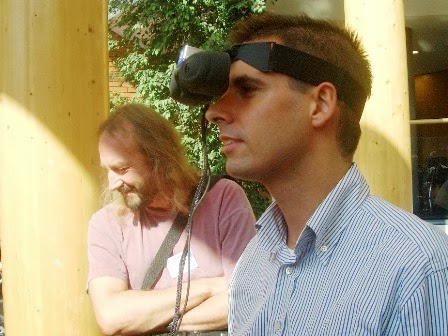
Juan González (IEArobotics/UAM) trying the visual control system of the robot Lauron-IV . Over the virtual reality glasses there is an inertial unit which identifies the movements of the head of Juan González. At his side is PhD. Enric Celaya (IRI)
Other interesting robot was the quadruped "AIMEE" from the University of Bremen, Germany, built with high efficiency valued in 500€ each (2005). The robot is able to walk, turn and creep when it has to overcome difficult areas or high ramps. The University of Bremen works in other interesting robotics projects in cooperation with so well known organizations as ESA, NASA or DARPA.
Quadruped AIMEE of the University of Bremen (Germany)
PhD. Man-Wook Han from the Vienna University of Technology showed his robot for space applications. Part of a project he is doing with ESA (European Space Agency). His robot could walk through a "spider net" in weightlessness.
PhD. Man-Wook Han (TU Vienna) with his robot for space applications. An his side is Alejandro Alonso (Quark Robotics)
The Shadow Robot Company showed their dexterous hand. It is a so realistic design that it has nails. The different joints are activated by artificial pneumatic muscles, composed by elastic structures with muscle shape that compress when they are inflated with air.
Juan González (IEARobotics/UAM) shanking hands with the robotics arm while Armando De La Rosa (The Shadow Robot Company) look with attention. The strength of the hand is really impressive, although adequately controlled.
Also they were very interesting robots in the climbing robots competition, were robots had to climb a vertical wall avoiding obstacles in the path. Some used magnetic methods with other used suction systems.
An undergraduate with his climbing robot
Other climbing robots that competed in the contest
As part of the event there was also a visit to the Climbing Robots Design Laboratory of the South Bank University, were they were different kind of robots, since the first climbing robot developed at Russia, to complex systems for verification of vertical pipes or liquid tanks.
From left to right. Alejandro Alonso (Quark Robotics), PhD. Anton Vitko (Slovak University of Technology) and Juan González (IEARobotics/UAM)
From left to right. Alejandro Alonso (Quark Robotics), Juan González (IEARobotics/UAM), PhD. Antonio Giménez (Robotics Lab UC3M), PhD. Ramón Barber (Robotics Lab UC3M) and Mario R. Arbulú (Robotics Lab UC3M)
Juan González (IEARobotics/UAM) and Alejandro Alonso (Quark Robotics) with Dirk Spenneberg (white shirt) from the University of Bremen and his team.
From left to right. Juan González (IEARobotics/UAM), PhD. Elena García Armada (IAI-CSIC), Samir Nabulsi (IAI-CSIC), PhD. Manuel Armada (IAI-CSIC) and Alejandro Alonso (Quark Robotics) during the conference banquet at the Royal Automobile Club.
From left to right. Alejandro Alonso (Quark Robotics), PhD. Roger D. Quinn (Case Western Reserve University - OH. USA) and Armando De La Rosa (The Shadow Robot Company)
From left to right. William A. Lewinger and Kathryn Daltorio (Case Western Reserve University - OH. USA) and Juan González (IEARobotics/UAM).
From left to right. Alejandro Alonso (Quark Robotics), PhD. Domenico Longo (University of Catania. Italy) and Juan González (IEARobotics/UAM)